> ## Documentation Index
> Fetch the complete documentation index at: https://docs.xpander.ai/llms.txt
> Use this file to discover all available pages before exploring further.
# Asana
> Learn how to integrate AI agents with Asana using xpander.ai. Create intelligent workflows that automate routine tasks, assign responsibilities, and provide real-time insights to enhance team productivity and decision-making.
## About Asana
Asana is a web-based and mobile work management platform designed to help teams organize, track, and manage their work.
Asana key features:
* **Task and Project Management**: Asana allows teams to create projects, assign tasks, set deadlines, and track progress. Users can organize work using various views such as lists, boards, calendars, and timelines.
* **Collaboration Tools**: Team members can communicate directly within tasks through comments, share files, and receive notifications, facilitating seamless collaboration.
* **Reporting and Analytics**: Asana provides real-time reporting features, enabling teams to gain insights into project statuses and identify potential risks or bottlenecks.
* **Integrations**: The platform integrates with various third-party applications, including Google Workspace, Figma, and Zoom, enhancing its functionality and adaptability to different workflows.
* **AI Capabilities**: In recent developments, Asana has introduced AI features like "AI teammates," which assist users by performing tasks, setting up triggers, and providing work analysis through a chatbot interface.
## Authentication Options
Below are possible authentication options you can choose:
### Generate an Asana API Key
1. Log in to your [Asana developer console](https://app.asana.com/0/my-apps).
2. Click **Create New Token** and give your token a name.
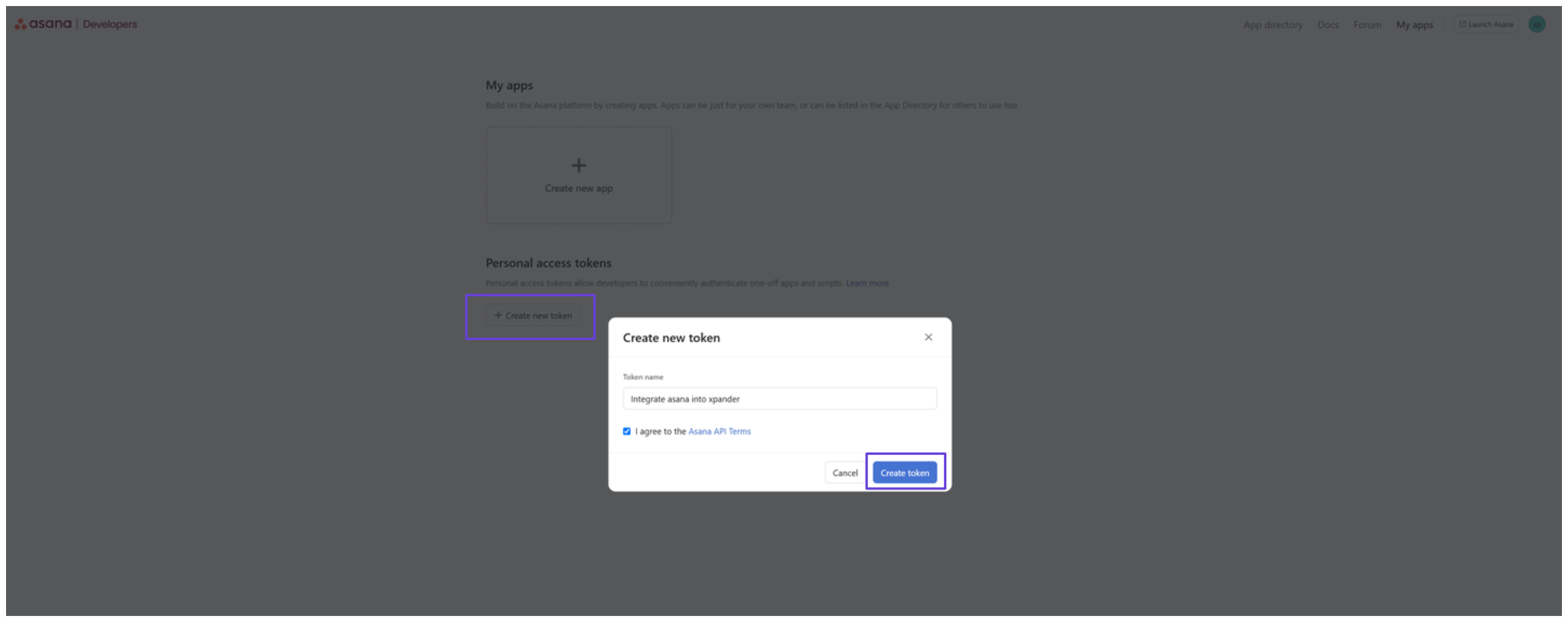 3. Your access token will be displayed—make sure to copy and store it securely.
### Integrate Asana into xpander.ai
1. In your xpander.ai dashboard, go to the **Connectors** section in the sidebar.
2. Select **Asana** from the list of available integrations.
3. Click **Other auth options**.
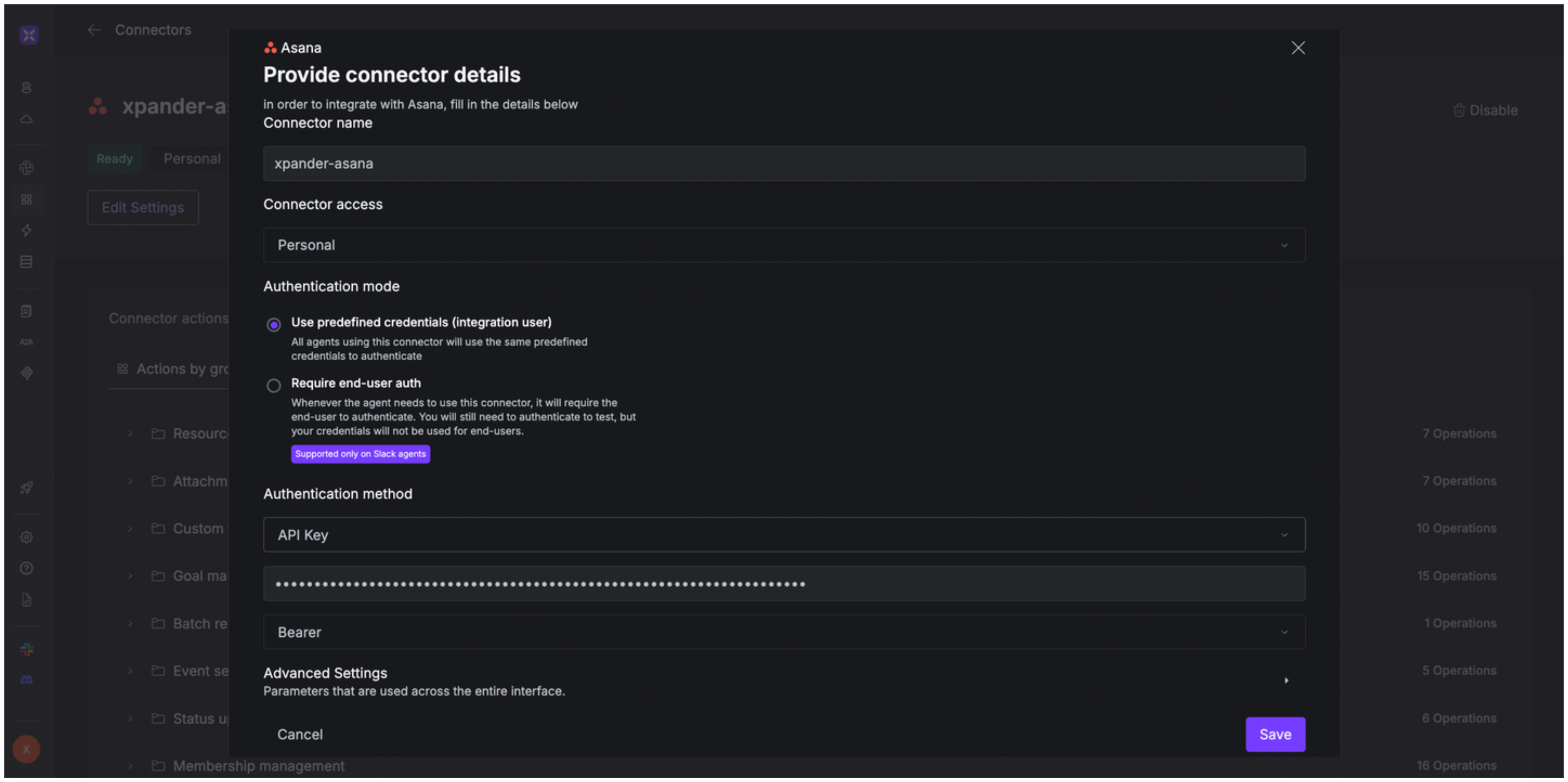
4. Enter a **connector name**, e.g., "xpander-asana".
5. Select **Integration User** for the authentication mode.
6. Choose **API Key** as the authentication method.
7. Paste your Asana access token into the provided field.
8. Set the **Auth Type** to **Bearer**.
9. Save the configuration.
3. Your access token will be displayed—make sure to copy and store it securely.
### Integrate Asana into xpander.ai
1. In your xpander.ai dashboard, go to the **Connectors** section in the sidebar.
2. Select **Asana** from the list of available integrations.
3. Click **Other auth options**.
4. Enter a **connector name**, e.g., "xpander-asana".
5. Select **Integration User** for the authentication mode.
6. Choose **API Key** as the authentication method.
7. Paste your Asana access token into the provided field.
8. Set the **Auth Type** to **Bearer**.
9. Save the configuration.
 ## Integration of Asana into AI Agent
Once you've configured your Asana account with the authentication option(s) described above, you can integrate it into your AI agent with xpander.ai:
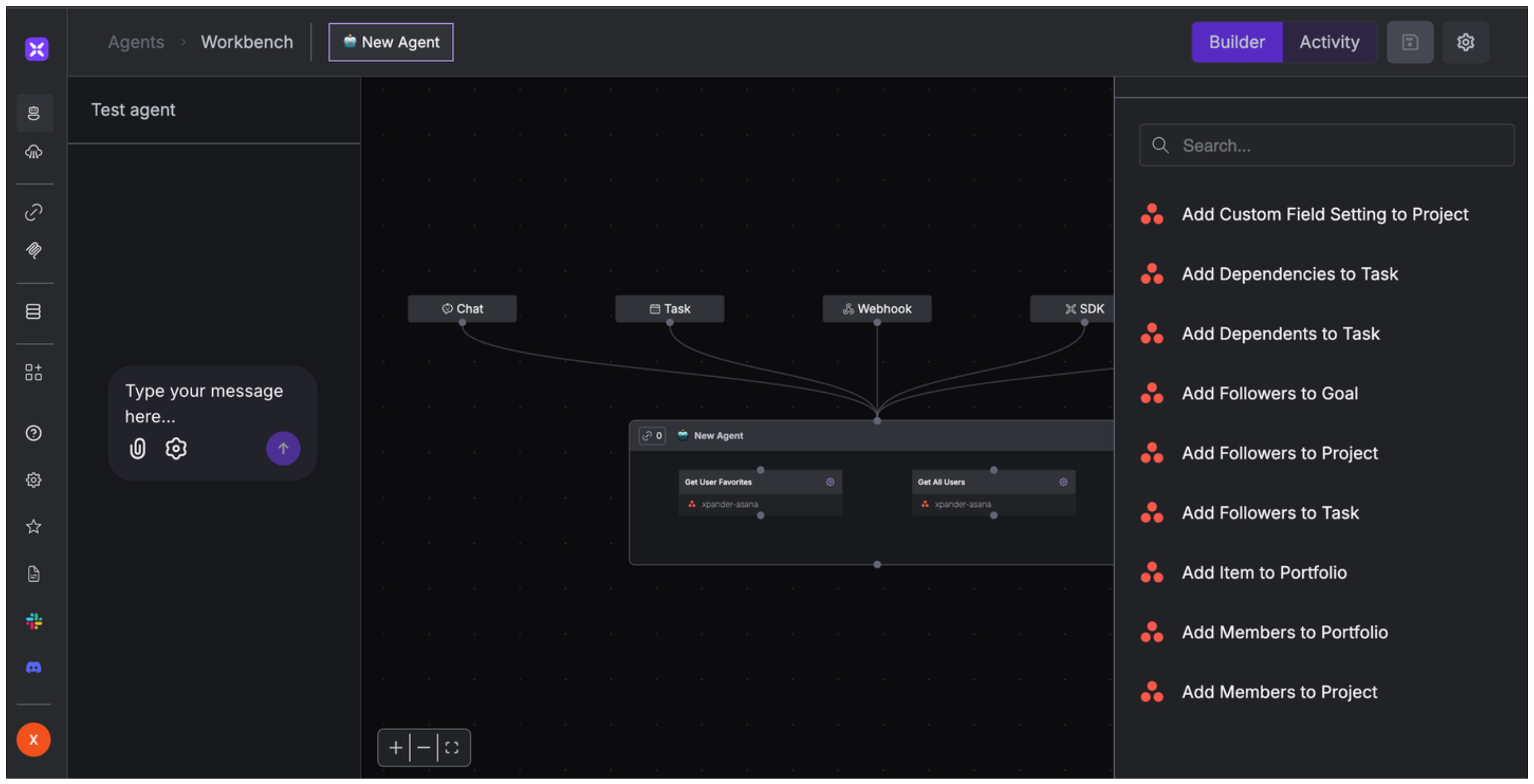
1. In your xpander.ai dashboard, go to the **Agent Configuration** tab and select **Tools**, then click **Add Tools**.
2. Select **Connectors**.
3. Choose **Asana** with the same **connector name** you configured in the previous section (e.g., xpander-asana).
4. Select the available Asana operations that suit your use case.
## Integration of Asana into AI Agent
Once you've configured your Asana account with the authentication option(s) described above, you can integrate it into your AI agent with xpander.ai:
1. In your xpander.ai dashboard, go to the **Agent Configuration** tab and select **Tools**, then click **Add Tools**.
2. Select **Connectors**.
3. Choose **Asana** with the same **connector name** you configured in the previous section (e.g., xpander-asana).
4. Select the available Asana operations that suit your use case.
 ## Expose Asana as MCP Server
Alternatively, you can also expose your Asana account as an MCP server. To do so:
1. In your **xpander.ai** dashboard, navigate to the **Connectors** section in the sidebar.
2. Select **Asana** with the same **connector name** you configured in the previous section (e.g., xpander-asana).
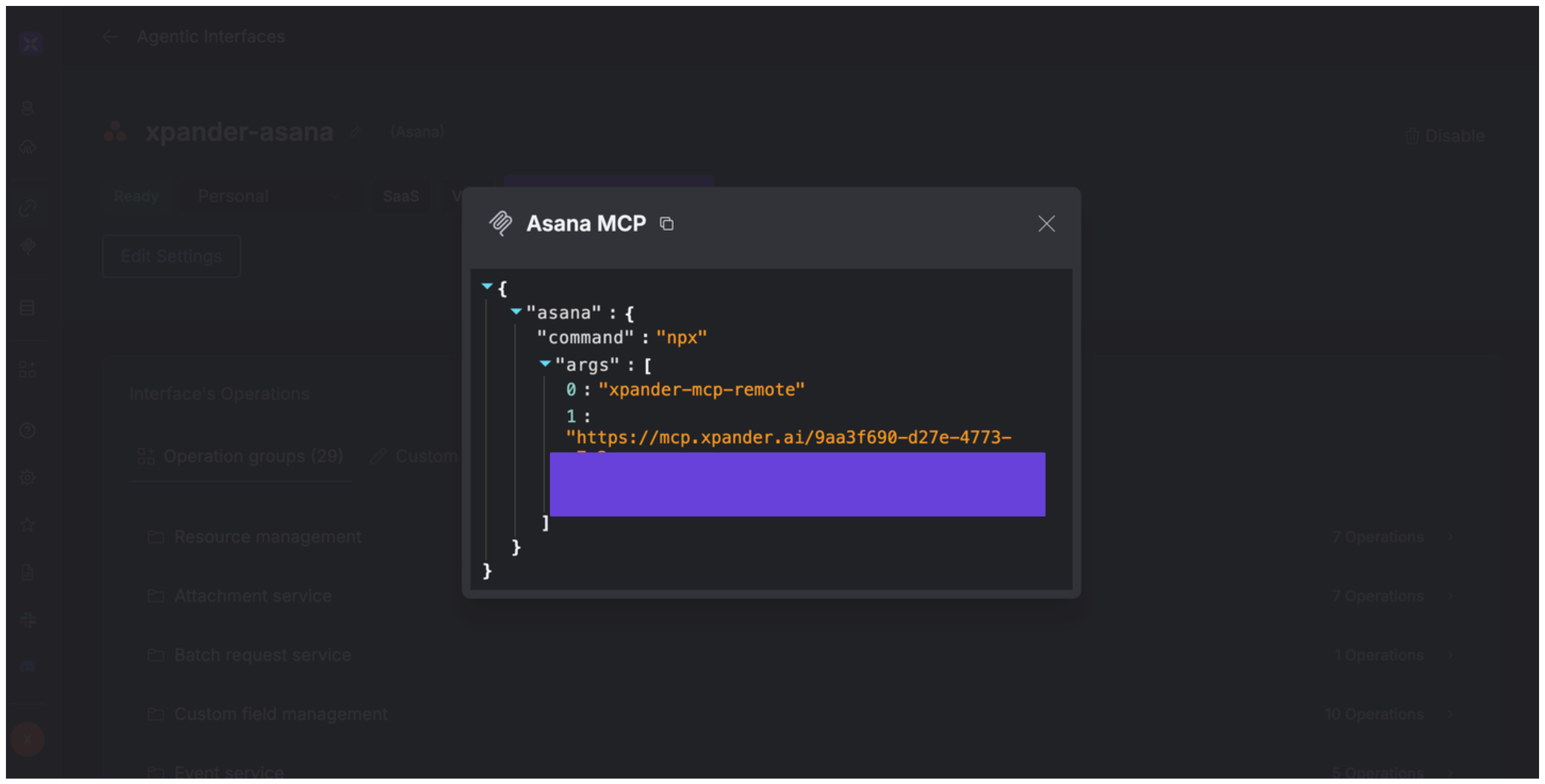
3. Click **MCP Configuration**.
4. Enter the MCP configuration into the appropriate settings of the client app you want to use (e.g., Cursor, Windsurf, Claude Desktop, etc.).
## Expose Asana as MCP Server
Alternatively, you can also expose your Asana account as an MCP server. To do so:
1. In your **xpander.ai** dashboard, navigate to the **Connectors** section in the sidebar.
2. Select **Asana** with the same **connector name** you configured in the previous section (e.g., xpander-asana).
3. Click **MCP Configuration**.
4. Enter the MCP configuration into the appropriate settings of the client app you want to use (e.g., Cursor, Windsurf, Claude Desktop, etc.).
 ## AI Agent Asana Prompt Library
Below are possible prompts or use cases you can try after integrating Asana into your xpander AI agent:
```
Could you create a new goal for Q3 titled "{goal_name}" and link it to our current objectives?
```
```
Can you upload the latest {document_name} brief to our project and notify the team?
```
```
Could you create a new project from our {template_name} template and set the due date to {date}?
```
```
Can you add {user_name} to the {project_name} project team and give them editor access?
```
## Related Resources
* [Understanding Model Context Protocol (MCP)](/guides/deploy/mcp)
* [Asana API Documentation](https://developers.asana.com/reference/rest-api-reference)
## AI Agent Asana Prompt Library
Below are possible prompts or use cases you can try after integrating Asana into your xpander AI agent:
```
Could you create a new goal for Q3 titled "{goal_name}" and link it to our current objectives?
```
```
Can you upload the latest {document_name} brief to our project and notify the team?
```
```
Could you create a new project from our {template_name} template and set the due date to {date}?
```
```
Can you add {user_name} to the {project_name} project team and give them editor access?
```
## Related Resources
* [Understanding Model Context Protocol (MCP)](/guides/deploy/mcp)
* [Asana API Documentation](https://developers.asana.com/reference/rest-api-reference)