

Providers
Where keys live
Three places, checked in this order for a model call:- An agent-level credential on one agent.
- An organization-level key per provider under Settings > LLM settings (Add key on a built-in provider, Add custom provider for your own endpoint, Workspace defaults for the default model).
- The install’s keys on a self-hosted cluster: chart values
secrets.static.<provider>ApiKey, or a Kubernetes secret referenced withenvFromSecretKeys.
xpander-static secret has a Helm keep policy; if a key is not picked up after an upgrade, patch the secret directly and restart xpander-agent-worker. The full value-to-secret mapping is on Hybrid: managing LLM API keys.
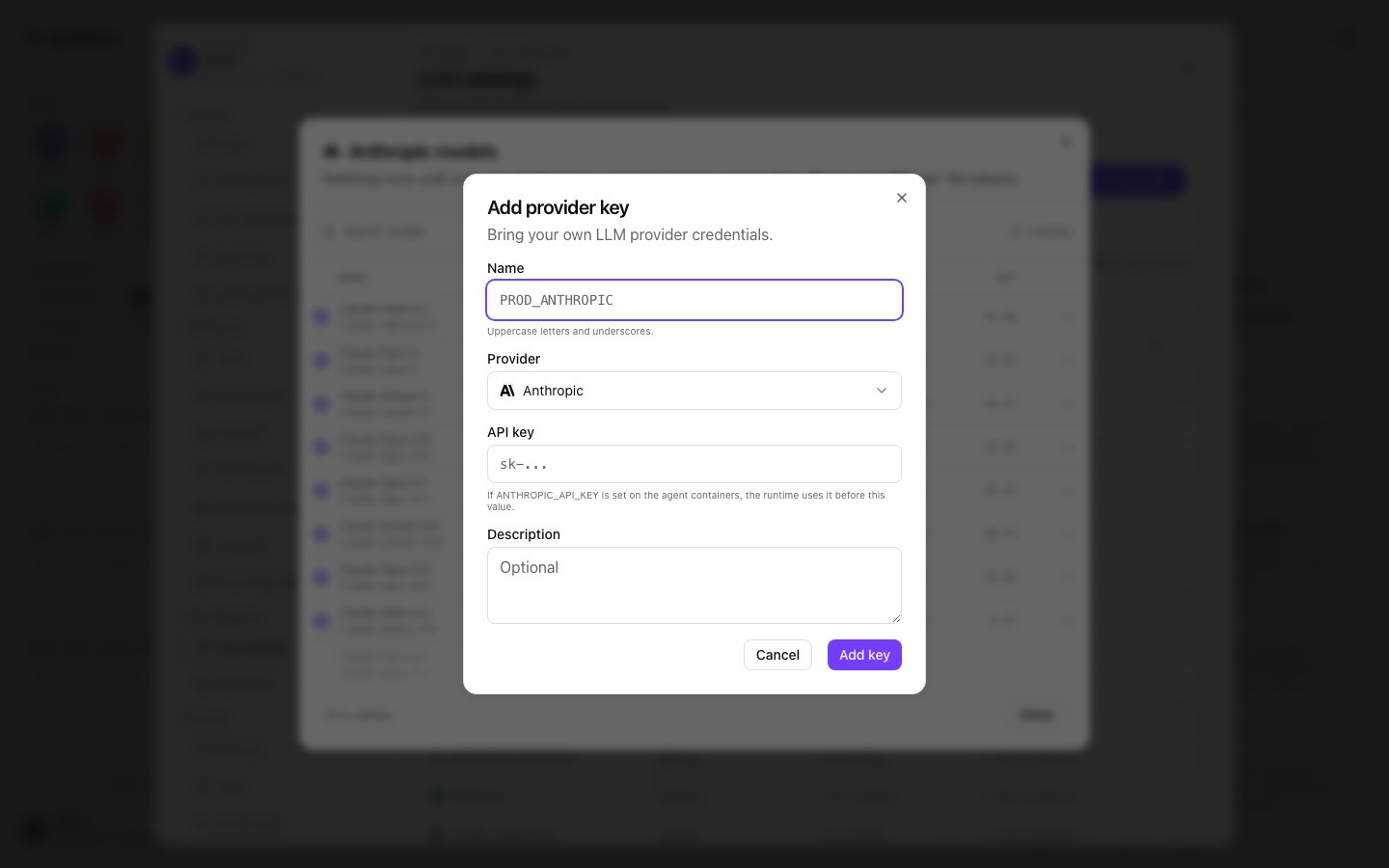
Add provider key for a built-in provider: name, provider, API key, optional description. Shown with sample data.
Credits against your own keys
Model calls are charged in credits when they run on keys xpander provides. A call that runs on a key you brought, agent-level or organization-level, is never charged credits. Hybrid relays xpander’s vendor keys but never Bedrock: Claude Code on Bedrock on a Hybrid install needs your own Bedrock auth on the controller.Provider setup on a self-hosted install
Claude Code speaks to Anthropic; Codex speaks to OpenAI; OpenCode takes any<provider>/<model> slot the proxy routes. Credentials live only on the Agent Controller.
Anthropic direct
An Anthropic API key on the controller, the same key wiring as the rest of xpander. The controller egresses toapi.anthropic.com; override the upstream with LLM_PROXY_ANTHROPIC_BASE_URL for a gateway of your own.
Anthropic on Amazon Bedrock
Claude Code can run Anthropic models on Bedrock through the proxy’samazon_bedrock leg. The controller resolves AWS auth in this order, and no executor ever sees it:
On Air-Gapped there is no public Bedrock: point
LLM_PROXY_AMAZON_BEDROCK_BASE_URL at a VPC (PrivateLink) Bedrock runtime endpoint and set the matching region, or leave Bedrock off. The Air-Gapped chart exposes all of this under global.llm.bedrock: region, bearerTokenSecret (a Secret you create carrying a Bedrock API key), assumeRoleArn and assumeRoleExternalId (the STS path), and baseUrl (the VPC endpoint the amazon_bedrock leg dials on a sealed install). Leave the token and the role empty to use the pod’s own credential chain (EKS Pod Identity or IRSA). On Hybrid, set the same variables on the Agent Controller through the chart’s env values.
Bedrock in a Hybrid deployment needs your own credentials. xpander cloud sends a Hybrid cluster its own Anthropic, OpenAI and Google keys, so agents work before you add anything and those calls are charged in credits. It never sends Bedrock credentials. Until an admin adds a Bedrock key or role under Settings > LLM, or the cluster has its own AWS identity for Bedrock, Claude Code agents there run on xpander’s Anthropic key. The Bedrock account also needs the opt-in above.
The keyless (role / Pod Identity) methods above apply to the AI gateway’s proxy on the Agent Controller. The
agent-worker service has a separate constraint on keyless Bedrock; see Amazon Bedrock: key vs IAM on the Hybrid page.Add a custom provider
Any endpoint that speaks the OpenAI-compatible API (vLLM, Ollama, NVIDIA NIM) is registered once for the organization under Settings > LLM settings > Add custom provider:- Name, and the Slug derived from it (lowercase, underscores).
- Protocol: OpenAI-compatible. Base URL: the address as the pods reach it, for example
http://vllm.<namespace>.svc.cluster.local:8000/v1. - API key: No key (local or unauthenticated server), Use an existing key, or Create a new key with a Key name and the key.
- Test connection under Models reports Reachable with the round-trip time and lists the models the endpoint serves; a model that accepts function calls carries a
toolsbadge. Add the models agents may use, then Add provider. - On the model row choose Set model cost and enter the Price per 1M tokens (USD) for Input and Output; the cache rates are optional. The dialog’s own words: “Agents can use the model once it has a cost.” The prices measure credit burn and are never charged.
POST /v1/agents accepts only the built-in providers in model_provider; a custom slug is refused with 422. A custom provider is picked per conversation instead. The composer’s Harness and model popover has a left rail with Claude Code, Codex and OpenCode: the Claude Code pane lists Amazon Bedrock and Anthropic, Codex lists OpenAI models, and OpenCode lists every provider, custom ones included. A custom model is selectable there once it has a cost. A local model also needs a context window well above the prompt xpander composes. A worked example, vLLM on a GPU node in the same cluster with the flags that make the probe pass and the context length that runs, is on Air-Gapped: a worked vLLM setup.
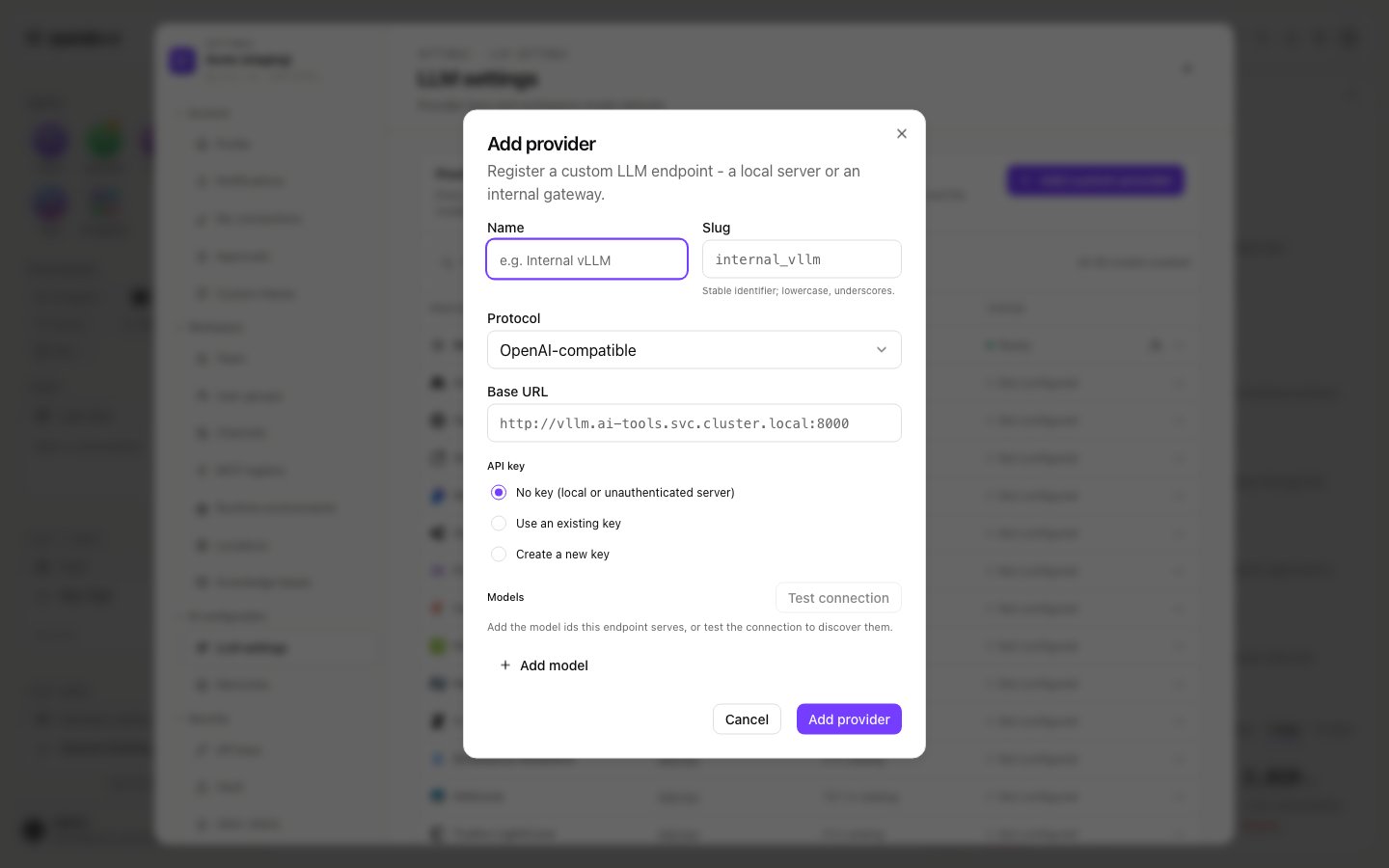
Add custom provider: name and slug, protocol, base URL, the API key choice, and Test connection under Models. Shown with sample data.
Which harness and model a new agent gets
A create that names a runtime, a provider, a model or harness settings is honored as written. A create that names none of them is defaulted, in the same order everywhere (cloud, Hybrid, Air-Gapped):-
The organization’s default LLM (Settings > LLM) maps to a CLI as follows:
- Anthropic maps to Claude Code, on that model.
- Amazon Bedrock with an Anthropic model id maps to Claude Code on Bedrock.
- OpenAI maps to Codex.
- Any other provider the LLM proxy routes maps to OpenCode, with that
<provider>/<model>slot.
-
The install’s default knobs (env on the
agentsandagent-controllerservices; on Air-Gapped the chart values below). -
The baked defaults: Claude Code on Anthropic direct with Fable 5.1 (
claude-fable-5-1), Codex ongpt-6-astra, OpenCode onanthropic/claude-opus-5.
Claude Code on Bedrock on Air-Gapped needs the chart’s harness defaults set.
global.harness.defaultProviders.claudeCode: amazon_bedrock and global.harness.defaultModels.claudeCode: <Bedrock model id> tell a defaulted agent to run Claude Code through Bedrock. Without them the agent targets Anthropic directly, and its first turn fails with 503 no anthropic credential configured for harness agents even when the organization’s default model is on Bedrock.
Model access per group
Settings > LLM settings lists which models each group may use. A model outside the group’s allow-list does not appear in the harness picker, and a run that names it is refused.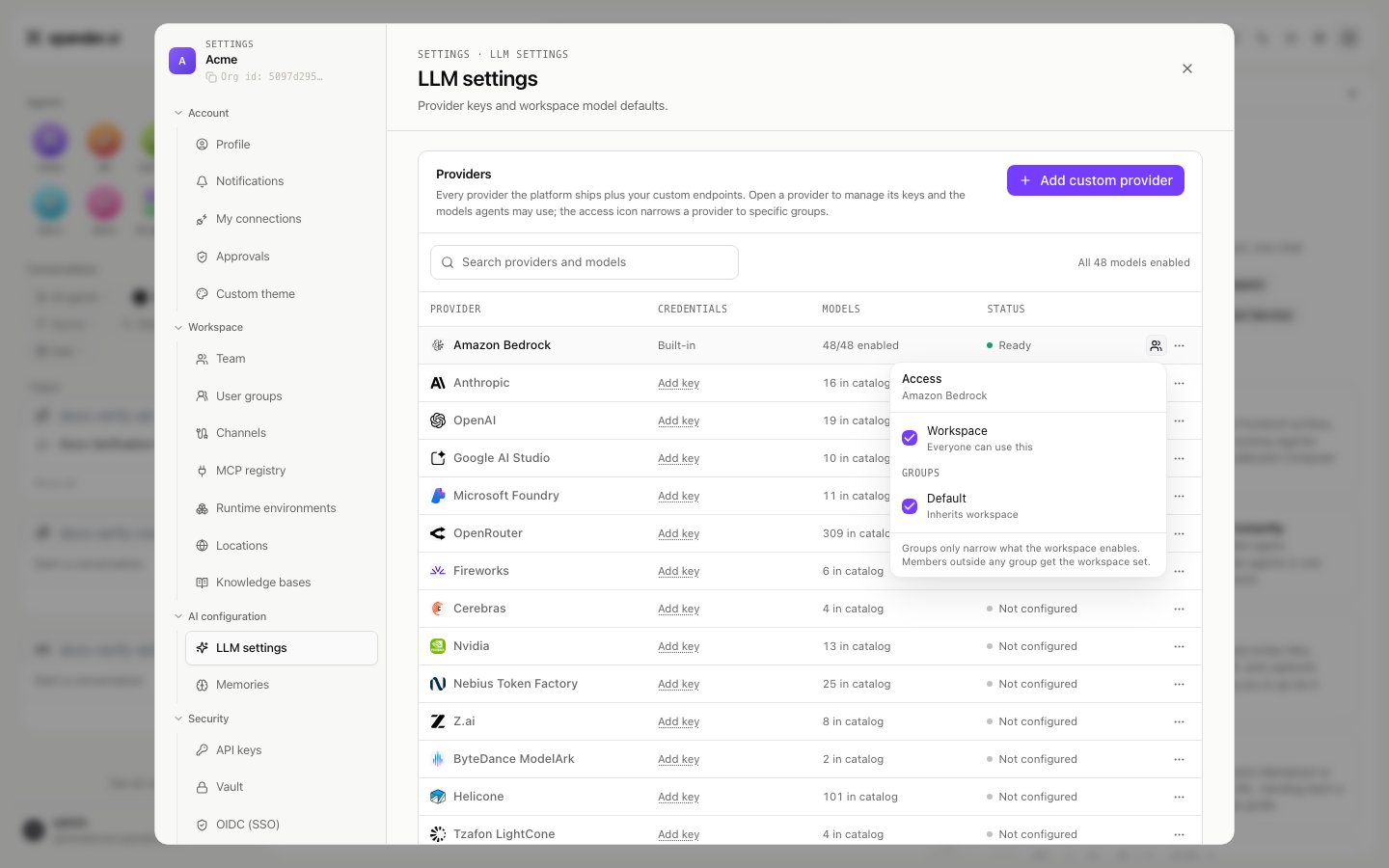
Access for a provider: a workspace-wide switch, then groups that narrow it. Shown with sample data.