

A location is where xpander runs your agents. In a cloud organization the only location is the xpander.ai cloud, which xpander manages. A Hybrid organization adds self-hosted locations, Kubernetes clusters you run yourself and connect with the Helm chart, next to the cloud. An air-gapped installation has no cloud location at all: its locations are its own clusters. In Xpander Chat, the location you are currently working against is your environment. This is a different thing from a runtime environment, the agent’s computer: the CLIs, packages, config files and standing context it finds installed on every run. A location says where that computer runs; the runtime environment says what is on it. See Runtime environments.

Locations in Settings

Organization admins manage locations in Settings > Locations. Each row names the location, marks it Managed (xpander.ai cloud) or Self-hosted with its address, and shows its status: Connected, Checking, Unreachable, or Setup incomplete for a cluster that has not connected yet. One location carries the Default badge; any row’s menu offers Set as default.
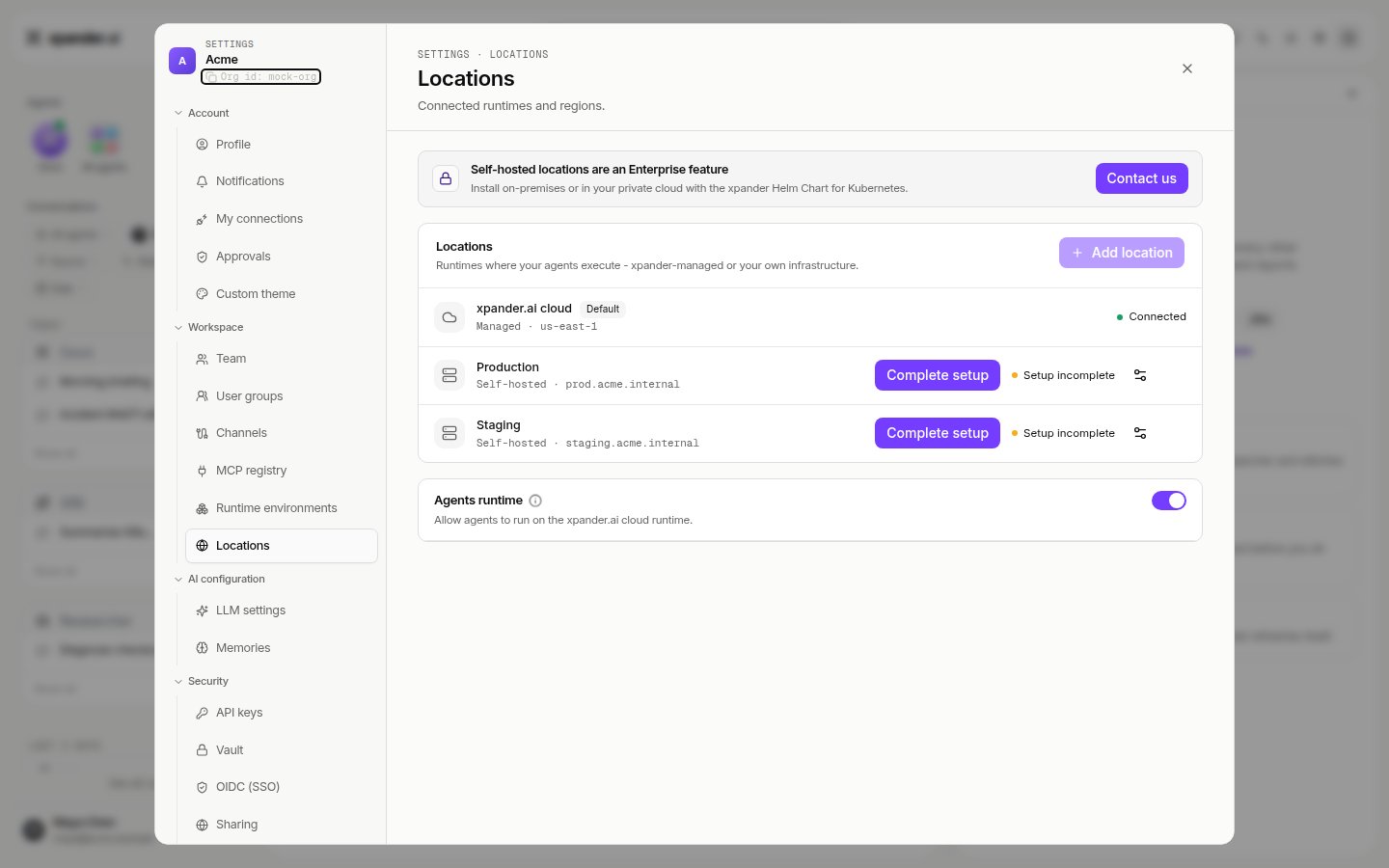
Locations tab in Settings

Settings > Locations, with a managed cloud row and a self-hosted cluster. Shown with sample data.
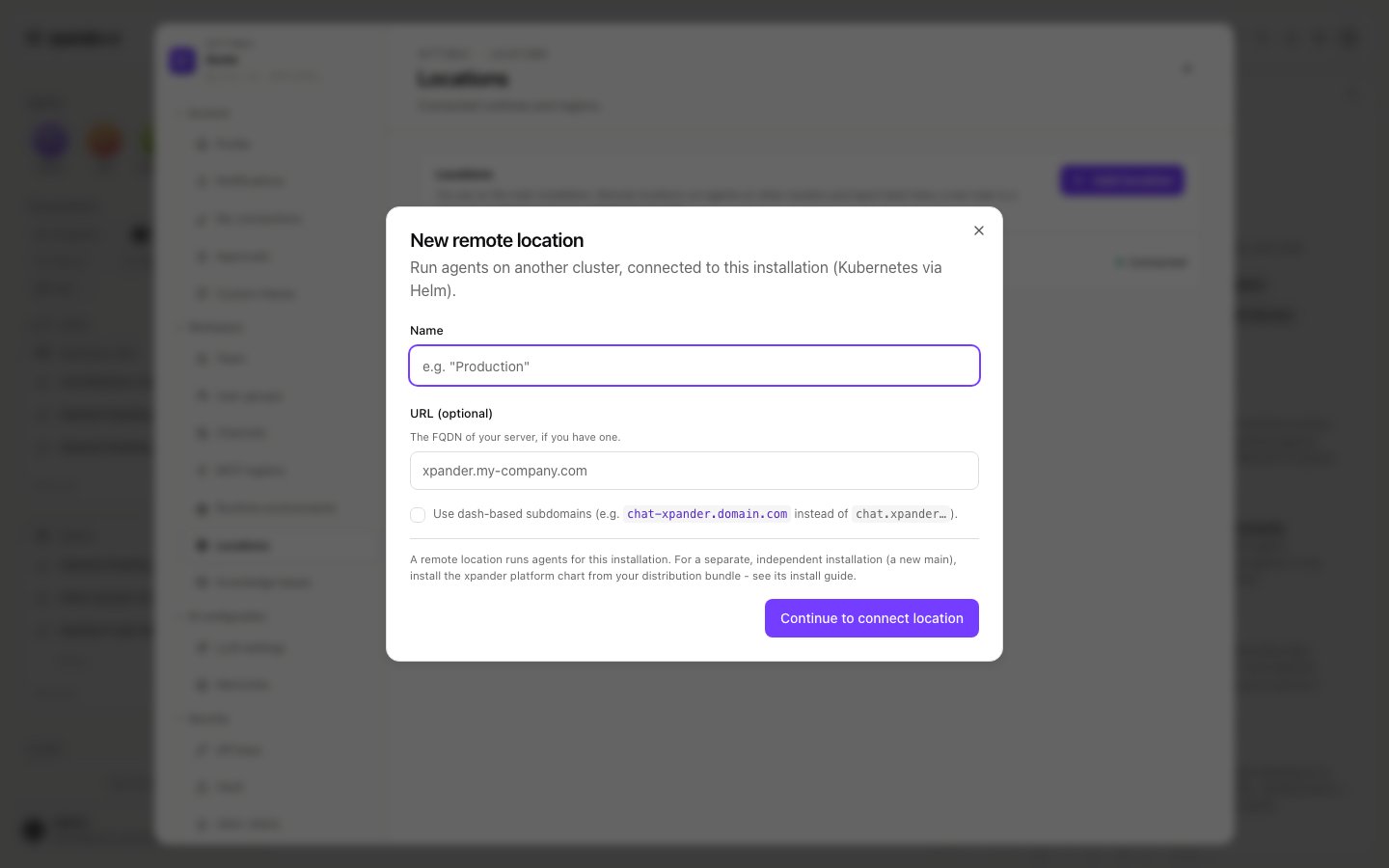
Add location walks you through connecting a cluster. On a cloud organization the dialog asks which deployment you are connecting. Hybrid keeps your data and agents in your cluster, while the control plane, the xpander services that manage agent and skill definitions, stays in the xpander.ai cloud. Air-gapped keeps xpander entirely in your environment, control plane included, and then has no cloud location. Self-hosted locations depend on your plan, and the tab tells you if a plan change is needed. On a licensed installation, where the whole org already runs air-gapped, the dialog is titled New remote location instead. It only asks for a name and an optional URL for the cluster you are connecting, since that new cluster joins the installation you are already on rather than choosing an edition of its own.
New remote location dialog

Add location on a licensed installation: New remote location, name and URL only. Shown with sample data.

Name it, run the snippet in your cluster’s terminal, and the row turns Connected once the cluster reports in. Installation guides are under Self-hosted, with the hybrid and air-gapped deployments covered separately. For a self-hosted row, the Cloud controls dialog decides what that cluster exposes through the xpander.ai cloud: Chat (talking to its agents through the cloud, including relaying when the cluster cannot be reached directly), Streaming (execution status and skill calls) and Scheduler (task scheduling from the cloud). Delete location removes the row; agents assigned to it stop running there.

Which location an agent runs in

An agent’s location is set when it is created. With more than one location, the New agent form shows an Environment picker with the default starred. Managed locations appear as xpander.ai cloud; self-hosted ones under their own names.

Switching environments

When your organization has a connected self-hosted location, the profile menu at the bottom of the sidebar gains an Environments section. It lists xpander.ai cloud (subtitled Managed) first, then each self-hosted location with its address. On a licensed installation the first row reads Main and This installation instead. Picking a row switches Xpander Chat to that environment; your choice sticks across visits, and until you pick you start in the organization’s default location.
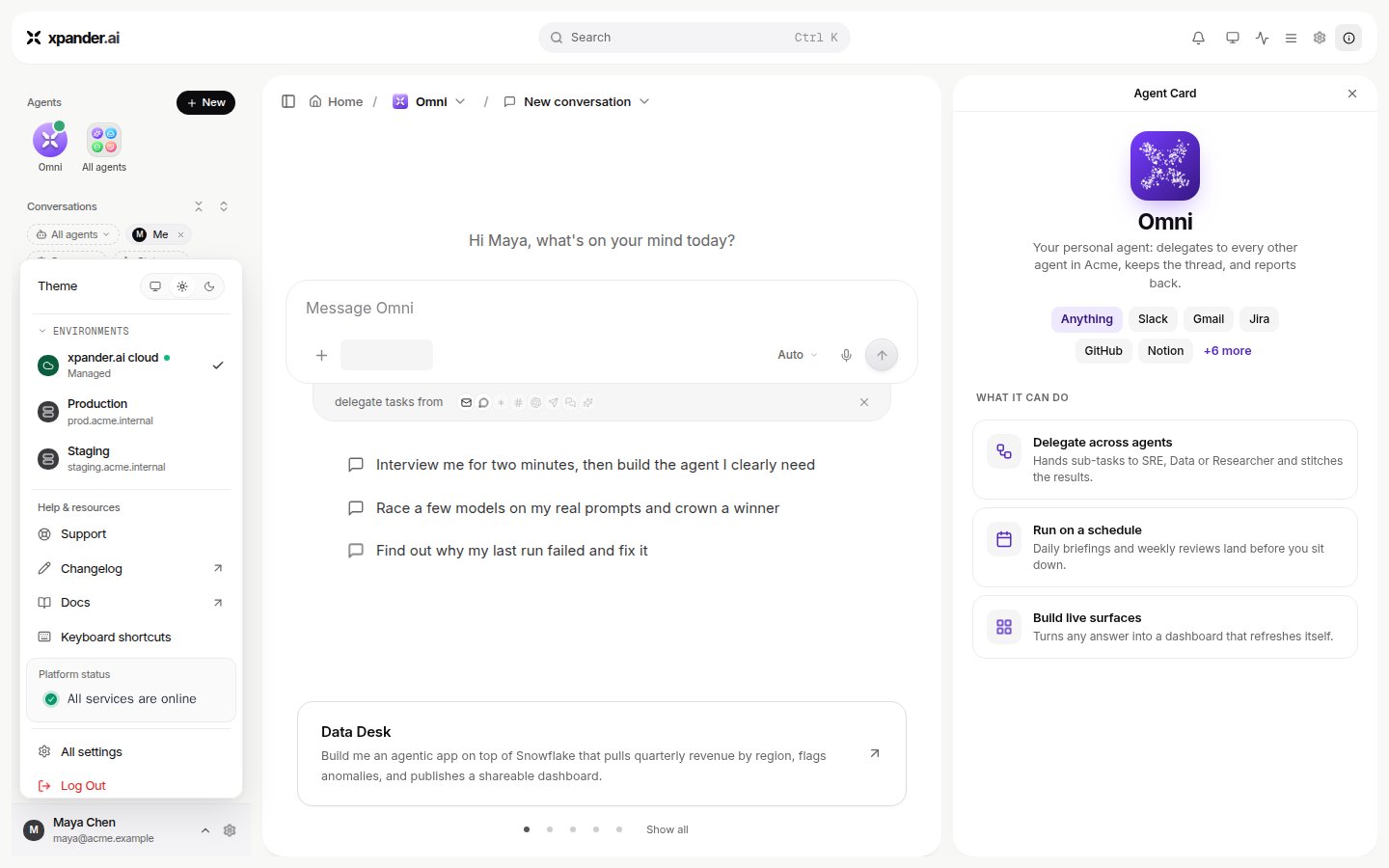
Environments section of the profile menu

The Environments switcher in the profile menu. Shown with sample data.

Agents are usable only in their own environment. Open one that lives elsewhere and the chat and workspace pause behind a notice naming both environments, with a Switch to button. The active self-hosted environment shows a live status dot in the menu and next to your name. When the cluster stops answering, the row reads Not connected and a callout suggests checking your VPN or using a different environment. If Chat is allowed in that location’s cloud controls, Xpander Chat keeps working through the xpander.ai cloud relay, noting that the file browser is unavailable until you reconnect. If it is not, Xpander Chat blocks until you retry, switch environments, or an admin opens the location’s settings.

The cloud location in a Hybrid organization

In a Hybrid organization the xpander.ai cloud stays one of your locations. Agents can run in the cloud or in your clusters. Admins decide whether the cloud stays available. Once a self-hosted location exists, Settings > Locations shows an Agents runtime row at the bottom with a switch labelled “Allow agents to run on the xpander.ai cloud runtime.” With the switch off, members work only with agents in your self-hosted locations. The cloud leaves the environment switcher and the New agent picker, new tasks on cloud agents are blocked, and a direct link to one shows a notice asking an admin to re-enable it in Settings > Locations. An air-gapped installation never shows this row. It has no cloud location, so there is nothing to switch.