

The Models page
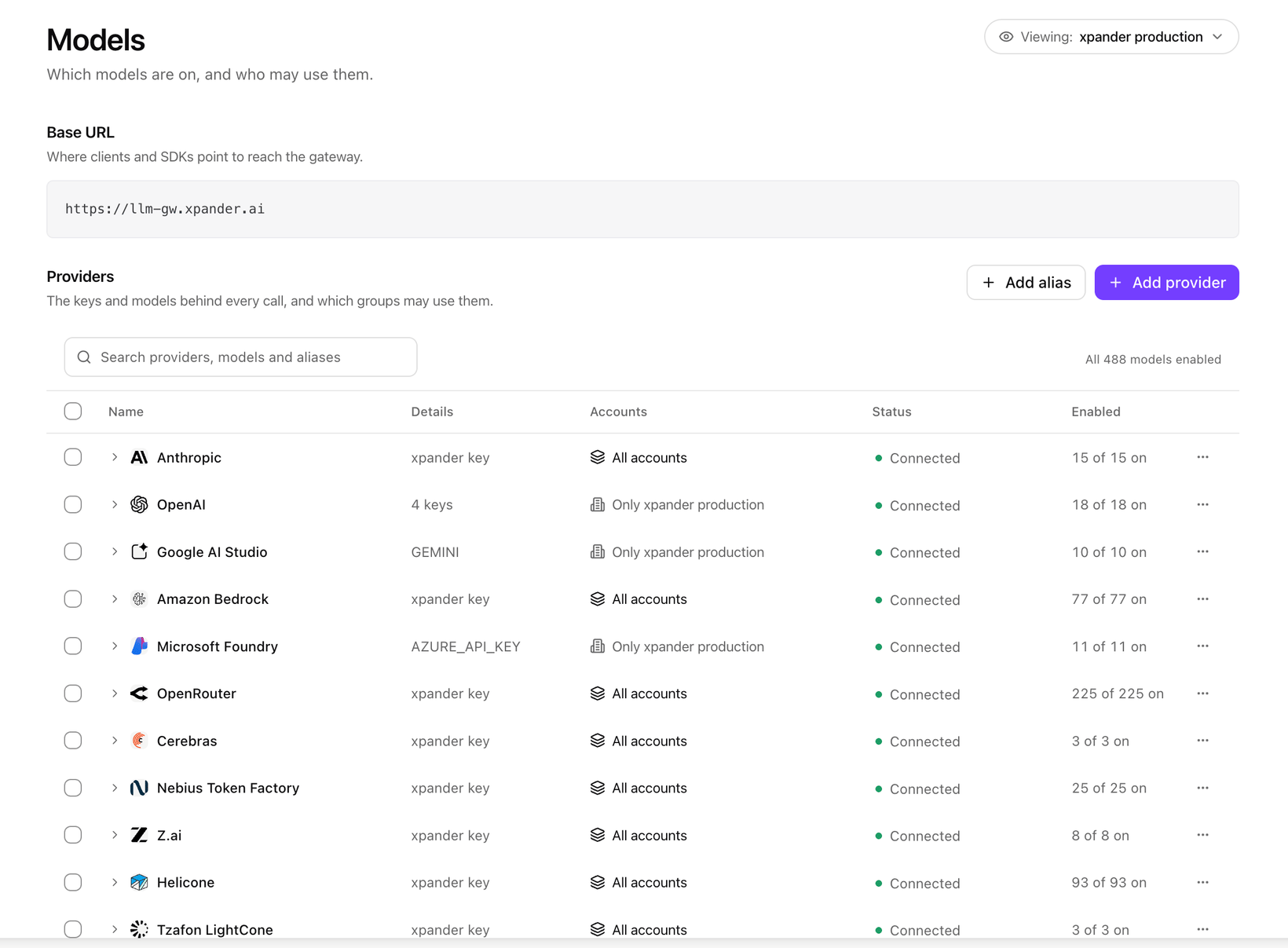
- Base URL: the gateway address clients and SDKs point at, with a copy button.
- Get started: a checklist until your first request: Connect a provider, Enable models, Create an alias (optional), Create an API key and Send a first request. It hides once the required steps are done.
- Providers: every provider with its keys and models. Columns: Name, Details, Status (Connected, Needs a key, All models off, Key error) and Enabled. Search with Search providers, models and aliases.
- Organization defaults: the provider, model and credentials new agents start with.
- Who can use what: a read-only view of which models each person and group can call (below).
Add a provider
On xpander cloud:- Under Providers, choose Add provider.
- Pick the Provider, such as Anthropic, OpenAI, Google Gemini, Amazon Bedrock or Microsoft Foundry.
- Paste the API key, and give it a Name in uppercase letters and underscores, such as
PROD_ANTHROPIC. Description is optional. - Choose Add provider.
Amazon Bedrock with an IAM role
Instead of an API key, Bedrock can use an IAM role in your AWS account. No secret is stored: xpander assumes the role for short-lived credentials on each use. In the add form, set Credential to IAM role and follow the trust and permissions policies the dialog shows. Then enter the Role ARN and Region, choose Test connection, and choose Add role. On xpander cloud, your organization ID is the external ID, sent every time the role is assumed, so only your organization can use it. The full steps, including Hybrid and Air-Gapped installs, are on Amazon Bedrock with an IAM role.Azure endpoint
An Azure key belongs to one Azure resource, so each Azure key carries the endpoint its calls go to.- When you add a Microsoft Foundry key, enter the Azure endpoint: the resource endpoint from Keys and Endpoint in the Azure portal, such as
https://my-resource.openai.azure.com. - Optionally set the API version, such as
2024-10-21. Leave it empty to use the default. - To change it later, open the key’s menu in the provider’s card and choose Set endpoint or Edit endpoint, then Save endpoint. Leave Endpoint empty to remove it.
Custom endpoints
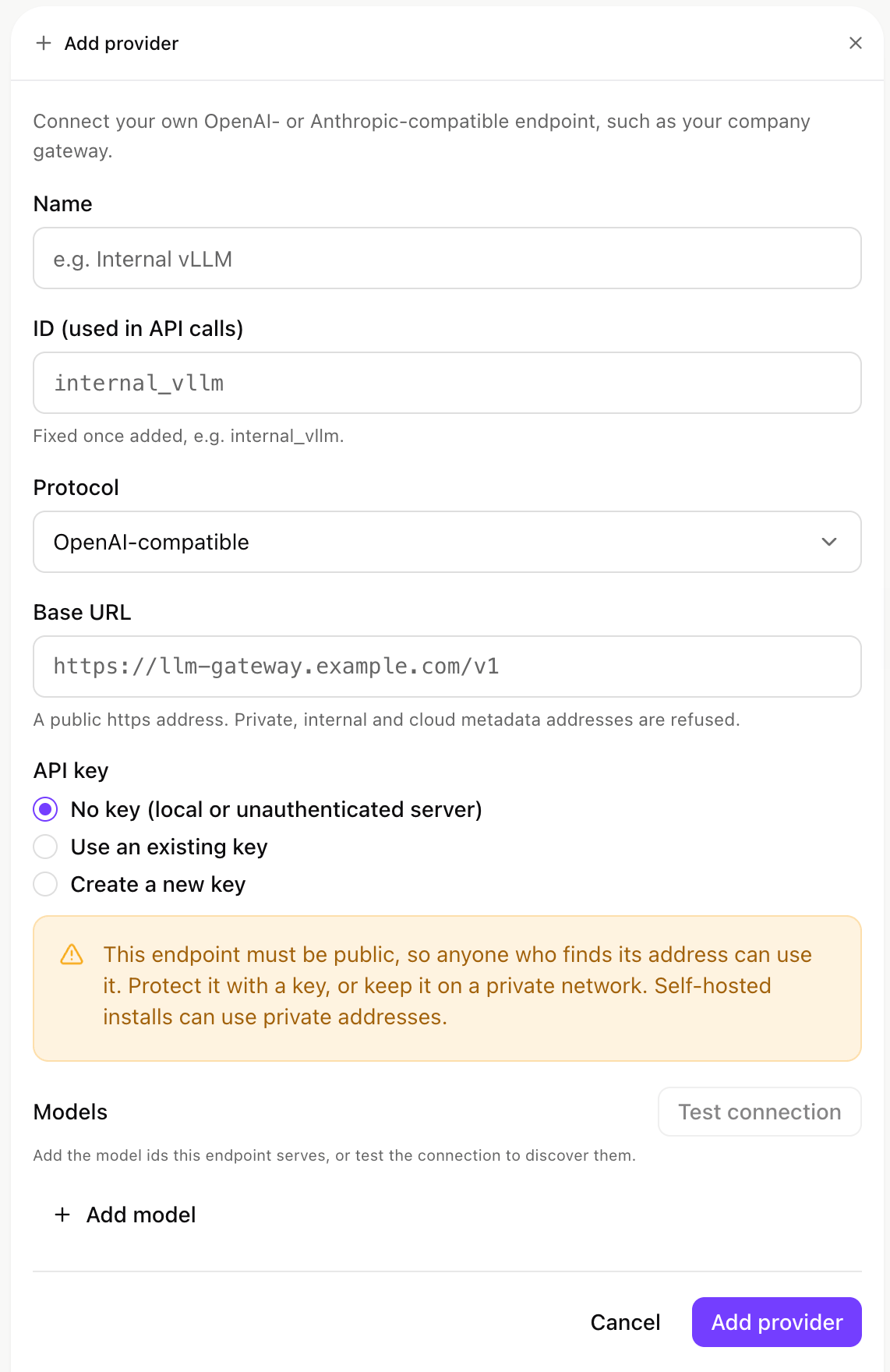
Adding a custom endpoint: name, ID, protocol, base URL, API key and models.
- Enter a Name and the ID (used in API calls), which is fixed once added.
- Pick the Protocol: OpenAI-compatible or Anthropic-compatible.
- Enter the Base URL: on xpander cloud a public
httpsaddress, such ashttps://ai-gateway.example.com/v1; on a Hybrid or Air-Gapped install it can be inside your network, such ashttp://vllm.ai-tools.svc.cluster.local:8000. - Pick a key: No key (local or unauthenticated server), Use an existing key or Create a new key.
- Under Models, choose Test connection to list what the server offers, or Add model to enter model IDs yourself.
- Choose Add provider. The models you listed are turned on for your organization; give each one a cost (Set model cost) so agents can use it.
A server with no key
Choose No key (local or unauthenticated server) for a server that does not check keys, such as vLLM or Ollama started without one.- Every call carries a placeholder in place of a key, never a real one. A server that does not check keys ignores it.
- Gateway callers name the model
<ID>::<model>, such asinternal_vllm::llama-3.3-70b. Agents use it like any other model. - Check now and Test connection work without a key.
- Calls through the LLM Gateway show in Logs under the provider’s ID, at the cost you set with Set model cost. They are not charged in credits.
Model endpoints on xpander cloud
On xpander cloud, every model endpoint you enter must be a publichttps address. This covers an Azure endpoint, an OpenAI-compatible endpoint and a model endpoint set on an agent. An endpoint at a private, loopback, link-local, cloud metadata or cluster address is refused when you save it: Model endpoints are called at public addresses here, so this endpoint was not saved. Use the endpoint’s public https address, or keep the provider’s own endpoint. Each call checks the address again, so a name that later resolves to a private address is refused too.
On a Hybrid or Air-Gapped install, an endpoint can be a private address inside your network. Link-local and cloud metadata addresses are refused everywhere.
Turn models on
Open a provider’s row (or Keys and models… in its menu) and tick the models the organization may use. Prices are USD per 1M tokens. A model that is off is refused for every caller. Disable provider or Disable model in a row’s menu stops it everywhere, after you confirm. A model blocked at the gateway shows Off (No one in the organization can use this model.); Unblock at the gateway in its menu lifts the block.Who may use which models
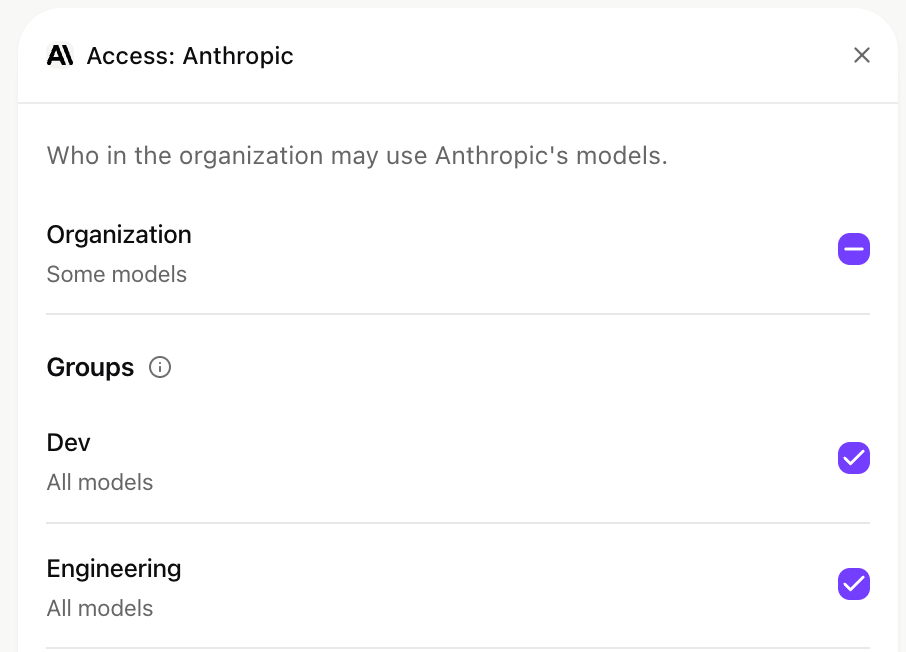
Choosing which groups may use a provider's models.
Whose key pays
A provider can hold several keys, for example one per team or cost center. A provider’s card shows its keys; the key the gateway uses across the organization carries Used by the gateway, and a key the provider refused shows Rejected by the provider. Under LLM gateway in the provider’s card:- Organization default picks the key everyone uses. Automatic lets the gateway pick.
- Give a group, person or agent its own key: pick the group, person or agent and the Key, then Assign. Remove an assignment with its X.
- Check a person or agent shows which key their calls use.
- the agent making the call
- the person making the call
- the person’s primary group
- the organization default for that provider