

Who may do what
Settings > Team lists members with a role each: Admin or Team member. Admins manage members, skills, providers, budgets and the settings on this page. Team members use and assemble agents within what admins approved. Invite by email; a member’s agents are listed against their name. Settings > User groups organizes members into groups with shared defaults. When single sign-on is configured, groups can follow the identity provider’s groups (OIDC group sync), so joiners and leavers are handled where your directory already handles them.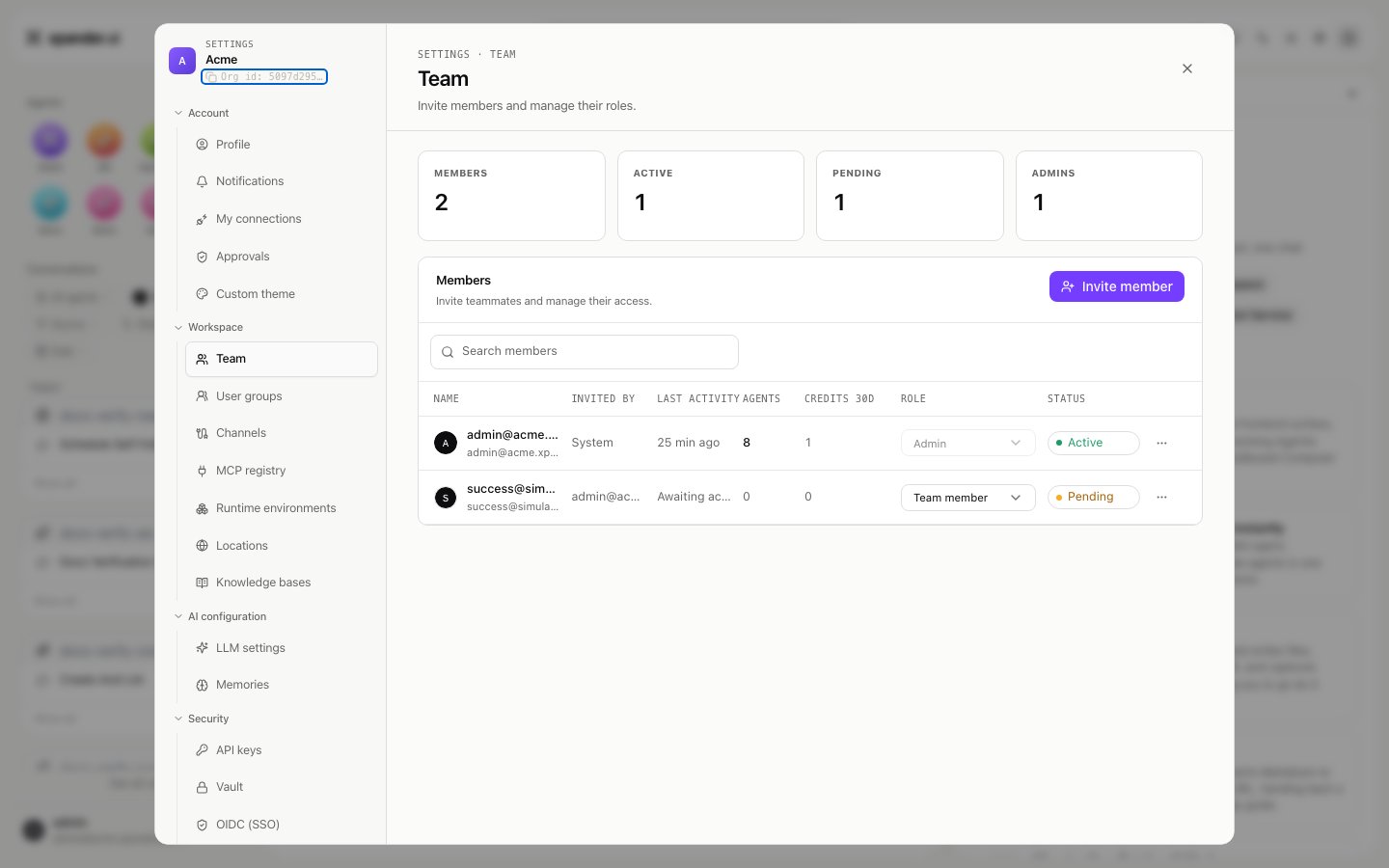
Settings > Team. Member counts, roles and status.
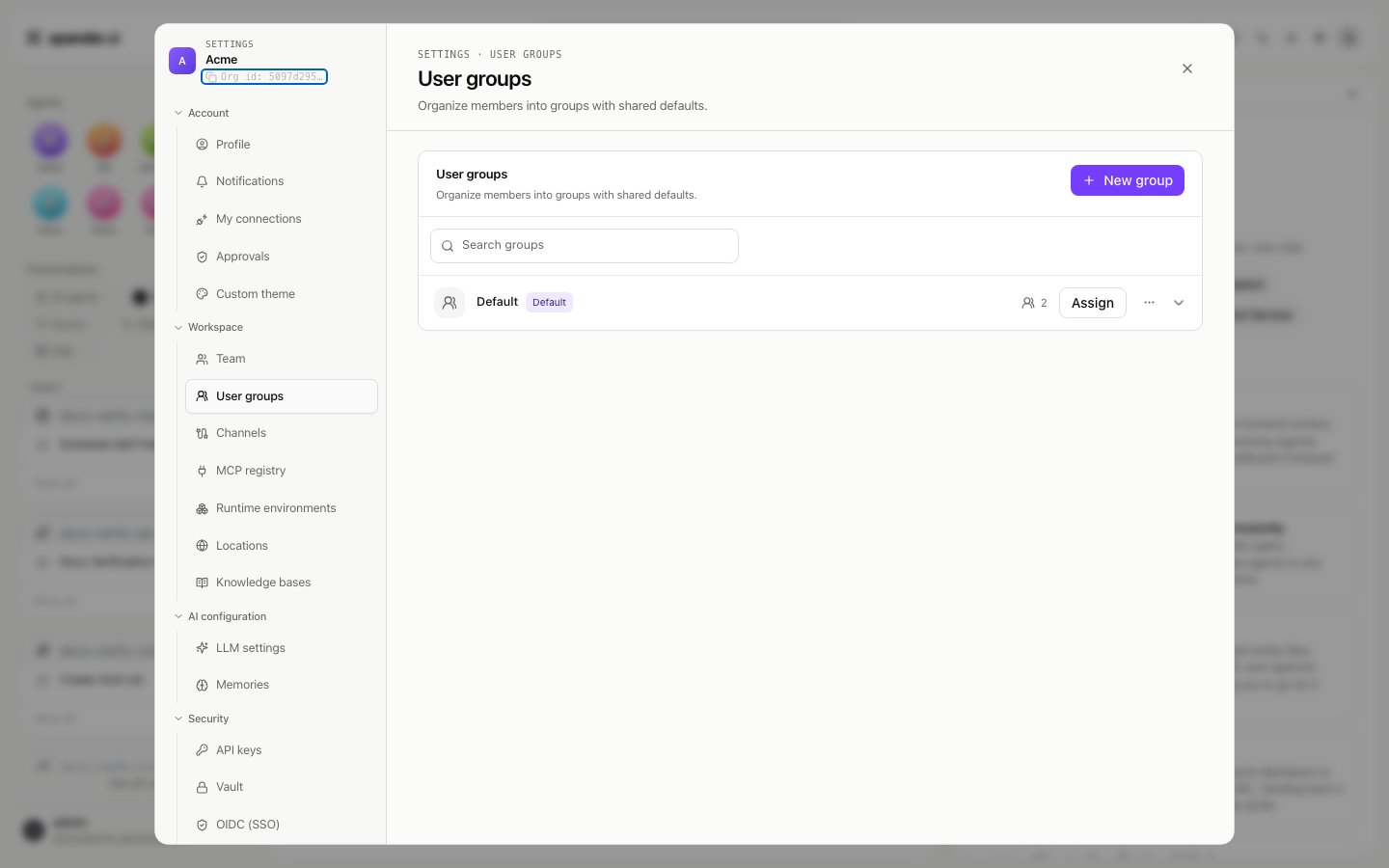
Settings > User groups. The Default group with its member count and Assign action.
Sign-in
Cloud and hybrid organizations sign in at Xpander Chat with email code, Google, GitHub, or your own identity provider over OIDC (Settings > OIDC (SSO), an enterprise feature). Air-gapped installs sign in inside the perimeter: a bootstrap password, email codes, or your OIDC provider. The setup is on SSO with your identity provider. Registration on xpander’s cloud is self-serve and free at chat.xpander.ai; Hybrid and Air-Gapped organizations are set up by their own admins.What an agent may reach: approved skills
A skill is one thing an agent can do in an outside system. Admins decide which skills exist for the organization and how each connects. On the agent, Add skill offers only what was approved. Each skill connection is either organization-wide (one account, shared) or personal (each person connects their own account, so the agent acts with that person’s permissions where systems allow). Skills served over MCP follow the same rule: an admin registers the endpoint once (Settings > MCP registry), then it is available to add.Approvals: risky actions wait for a named person
Three controls put an action on hold until a named approver clicks Approve:- On a skill, “These actions need approval” with the list of actions and who approves.
- Gated commands: for agents on Claude Code, Codex or OpenCode, text patterns that hold any shell command containing them.
- The run’s permission mode: Full runs commands, Gated holds the ones that match.
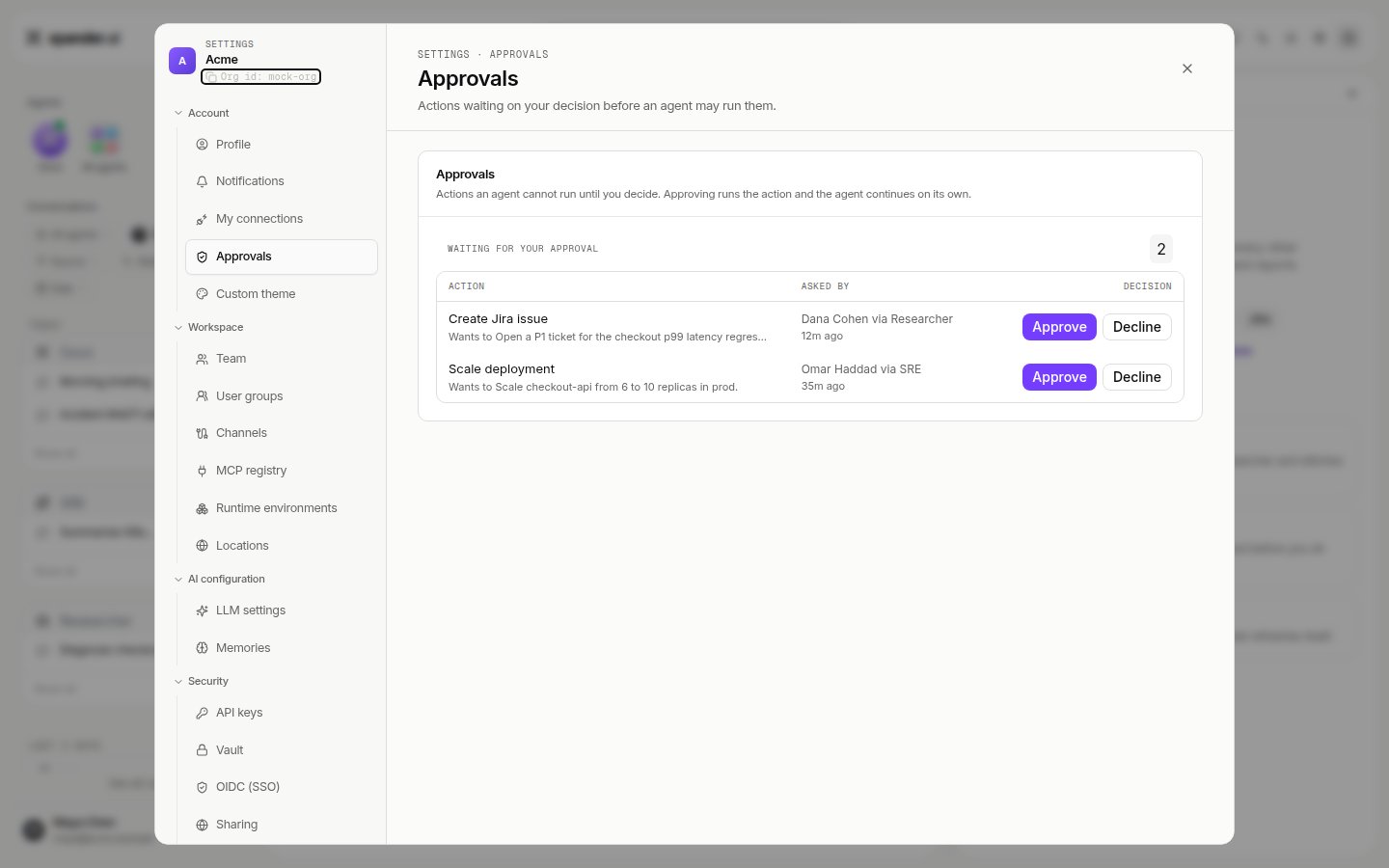
Settings > Approvals. Every action waiting for sign-off across agents. Shown with sample data.
Credentials: the agent never holds a secret
Settings > Vault holds every credential in the workspace, stored encrypted. Agents reference a secret; the value is injected at the moment of use and never appears in the agent’s prompt, files or record. An external vault (Azure Key Vault today) can be the source instead of xpander’s own store. Provider keys for models live under Settings > LLM settings and follow the same rule.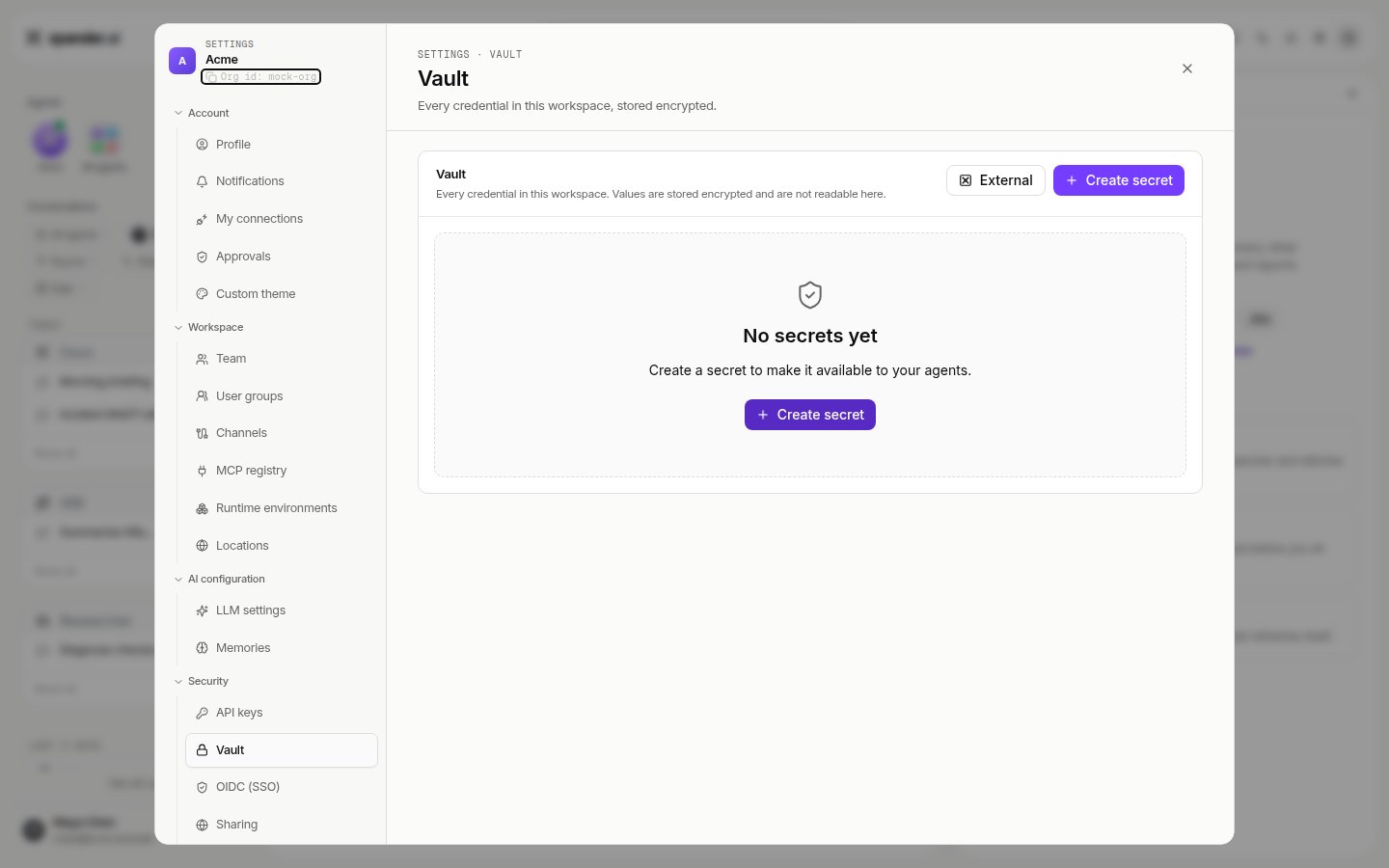
Settings > Vault. Credentials agents may reference but never see. Shown with sample data.
Models
Every model call from every agent goes through xpander’s AI gateway, so the providers, endpoints and models you configure here are the only ones an agent can reach. Settings > LLM settings lists the providers your organization uses, which are built in and which use your own keys, the default model new agents start on, and model access per group. Any provider, frontier or open-weight; on a self-hosted install, in-network endpoints and Amazon Bedrock over VPC endpoints are documented under Deploy.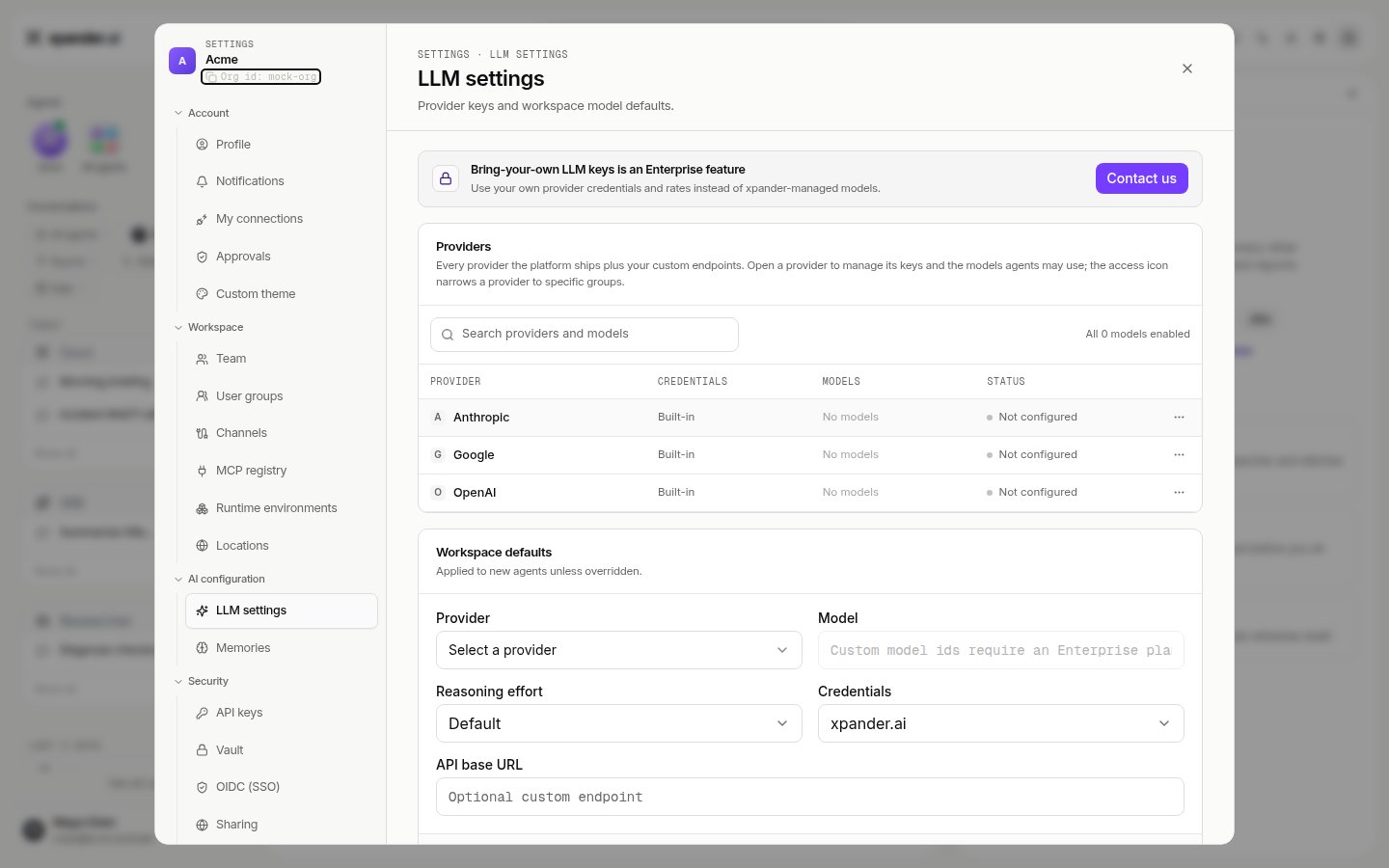
Settings > LLM settings. Providers, keys and the organization default model. Shown with sample data.
Budgets
Settings > Usage sets an organization spending limit: a monthly amount, with enforcement on or off. It also sets a ceiling for any single agent’s budget, and who is notified. Alongside these sits the usage breakdown, per agent, per person, and on each agent’s card. Every model call and skill call counts against these limits; a run that would exceed one stops and says so.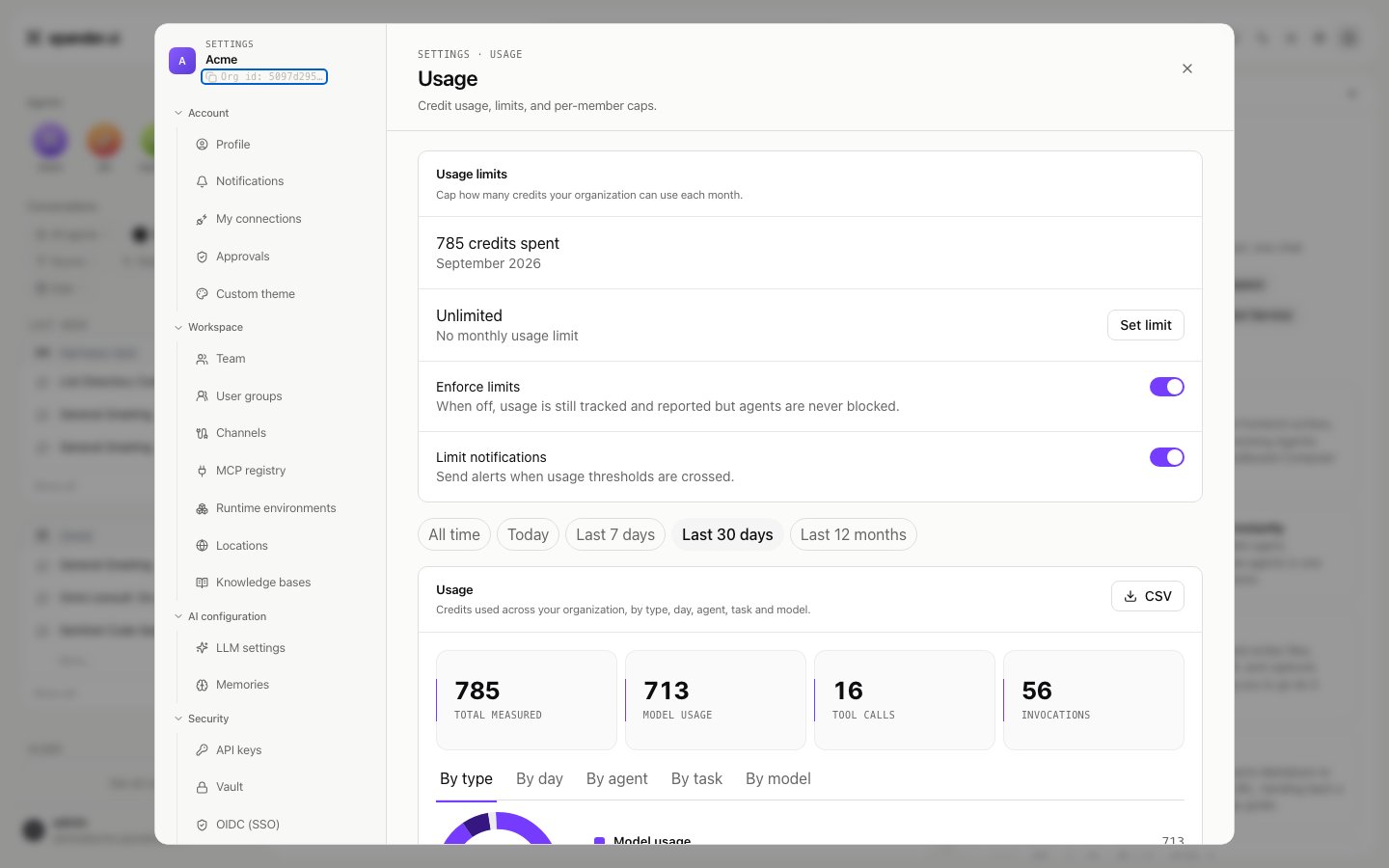
Settings > Usage. The organization limit, the per-agent ceiling and notifications sit above the usage breakdown.
Access to agents and what leaves the workspace
Each agent’s ACCESS row is Private, a group, or Org-wide; Manage access names who may use it. Settings > Sharing decides whether public links to shared apps and live surfaces are allowed at all; a public link works for anyone on the internet who has it.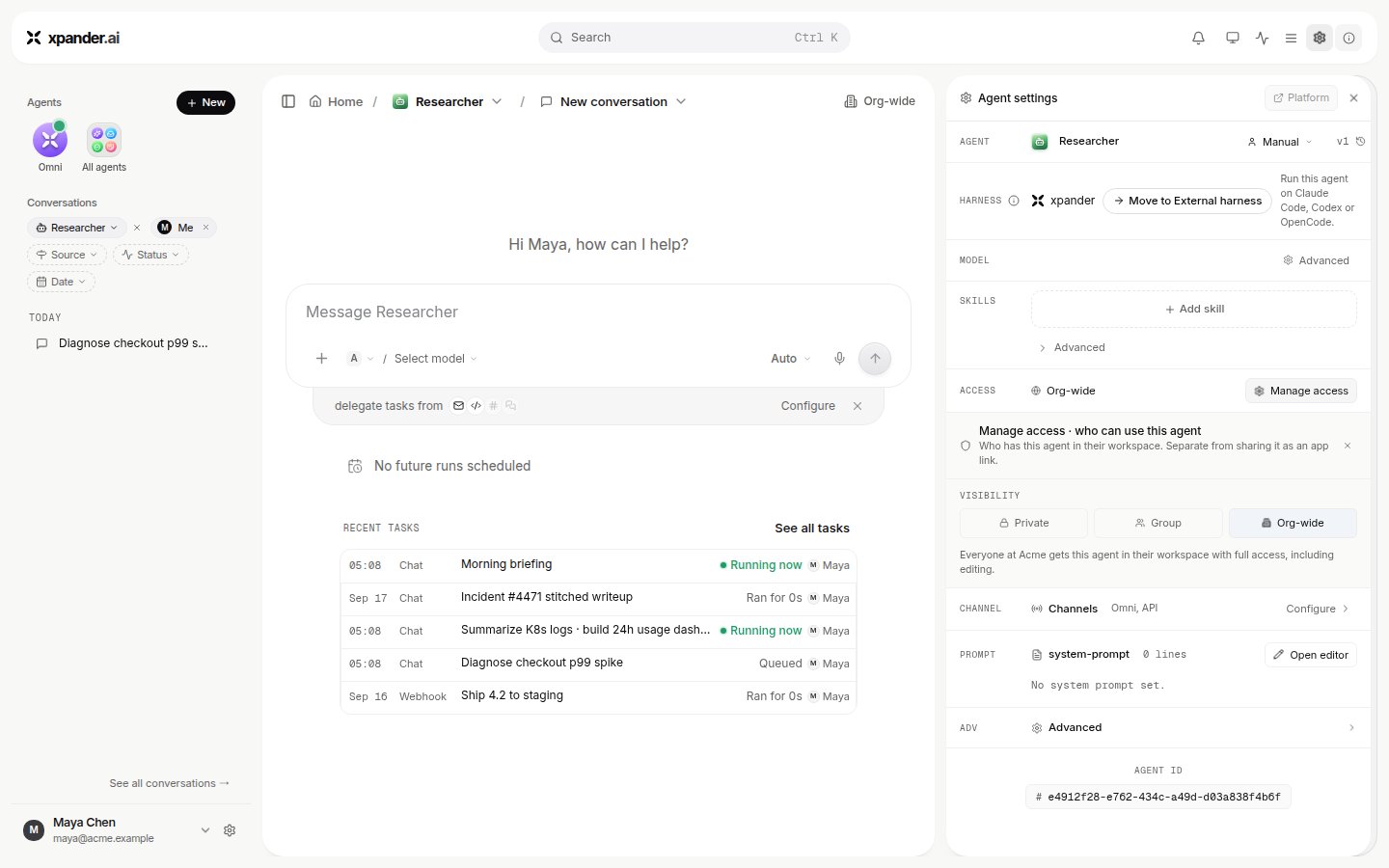
Manage access on an agent: private, a group, or the whole organization. Shown with sample data.
The record
Two places hold it. Every task. The Task Manager lists what agents did; a task’s thread holds every message, every skill call with its parameters and result, and every model call with its cost, under the person who asked. The same thread is available over the API (GET /v1/tasks/{id}/thread and /llm_usage).
Settings > Audit logs records these organization-level events as they happen, with the person who did them. Events are filterable by type and exportable as CSV or JSON; see Audit and debugging for detail. Events cover:
- agents: created, updated, deployed, deleted, shared, skills added
- skills: created, connected, connection changed or removed
- vault: secrets created, read, used, changed
- users and invitations
- user groups and OIDC group sync
- conversations: shared, revoked, deleted, renamed, files shared, workspace commands invoked
- organization settings