

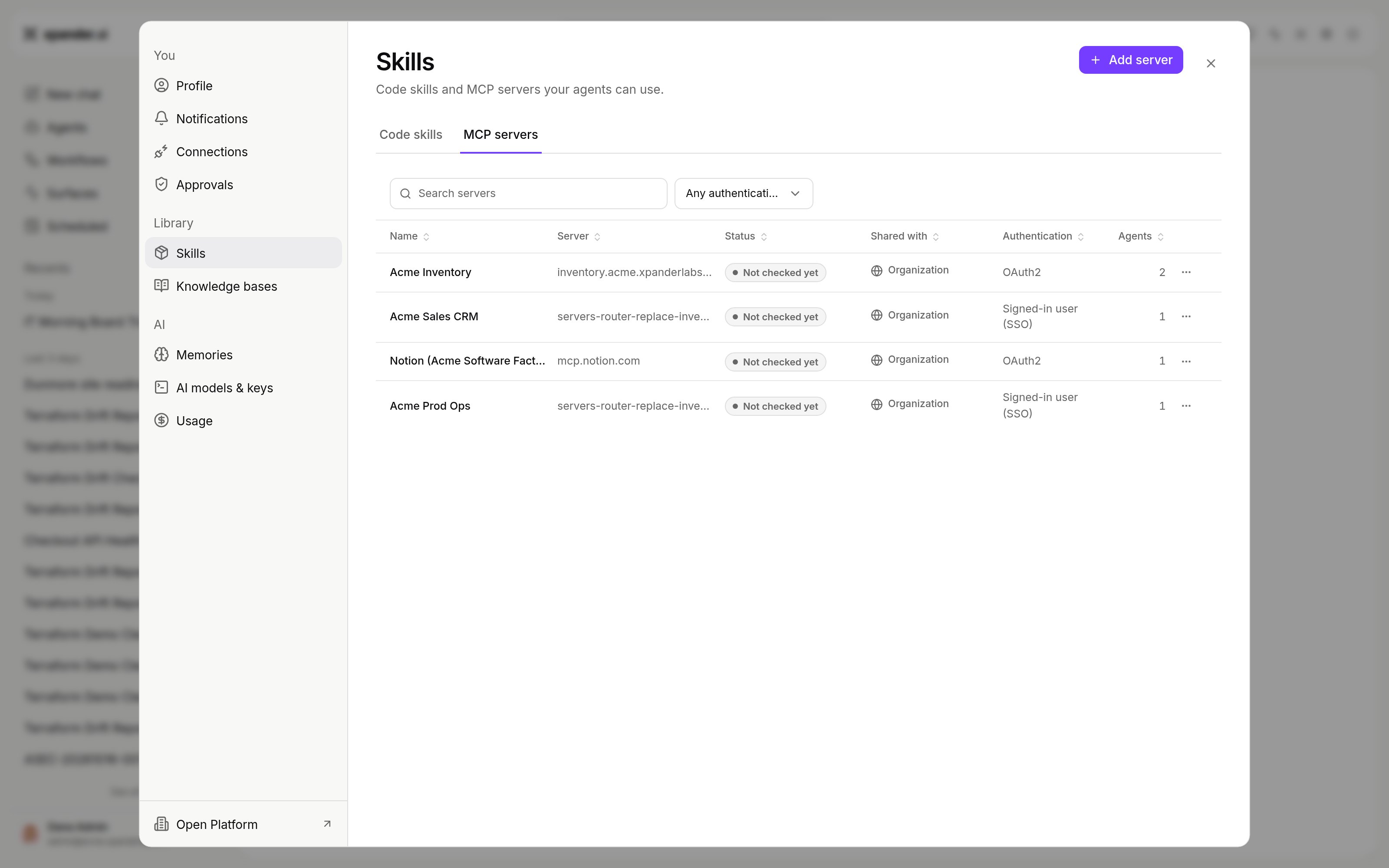
Settings > Skills > MCP servers with Add server. Shown with sample data.
Where to register an MCP connector
Server fields
Server fields
Every place takes the same fields: Name, Server type (Remote or Local), Server URL, Transport (HTTP or SSE), Authentication (None, API key, OAuth2, Headers or Signed-in user (SSO)), and an optional Health check. For Signed-in user (SSO), Token sent is Access token, ID token or Exchange for an audience (with an Audience).
Set how it reaches agents
In the Skills registry, Off removes it everywhere. Optional leaves it for each agent to add. Auto-injected and On by default put it on every agent in its audience. Its actions can be gated for approval like any skill’s. Local stdio entries (auvx ... command) work on Air-Gapped too.
Whose credential the MCP connector receives
See whose credential a shared agent uses.
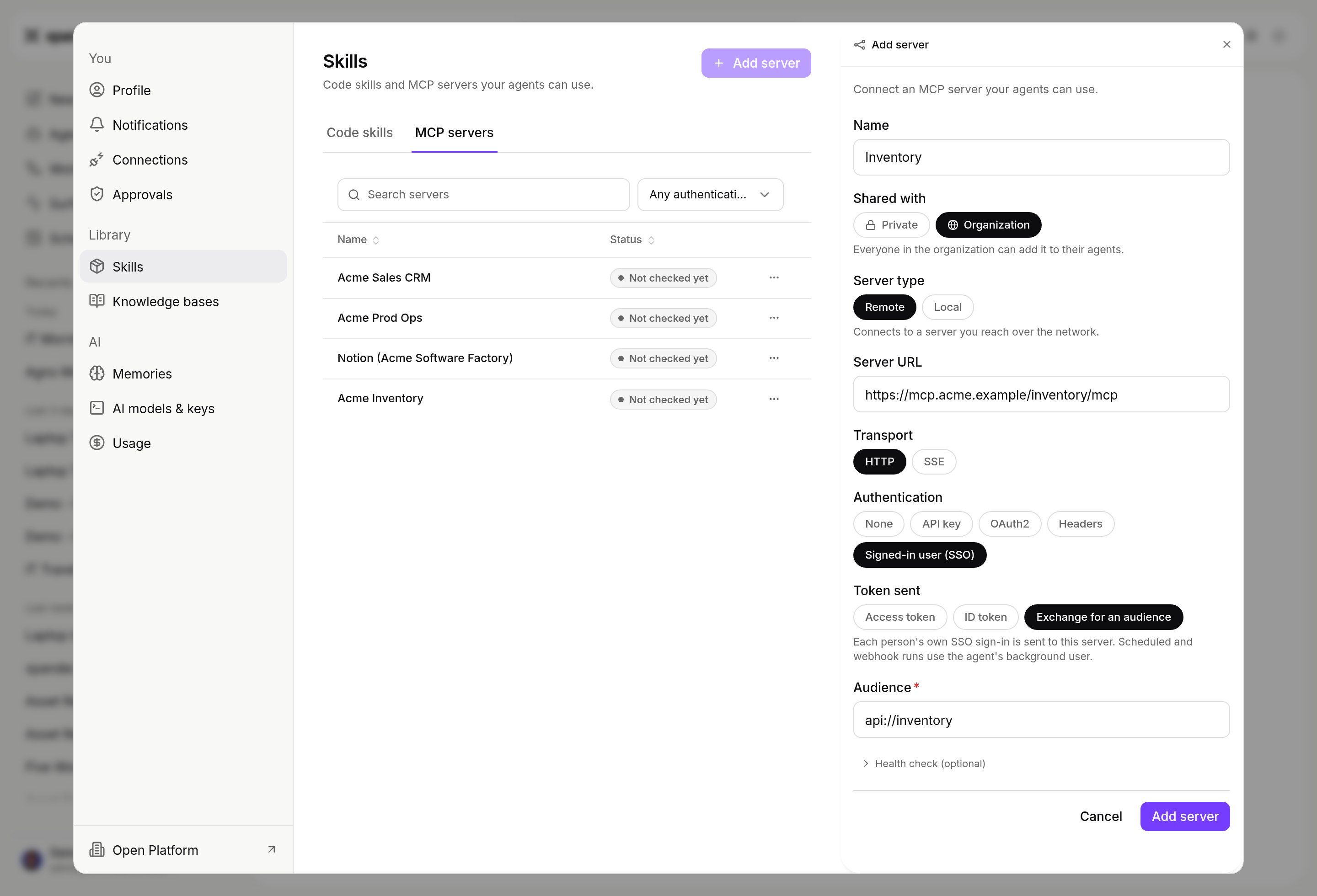
Add server with Authentication set to Signed-in user (SSO), Token sent set to Exchange for an audience, and an Audience. Shown with sample data.
How calls behave
- Remote MCP connectors use HTTP or SSE. Local stdio entries run in the agent’s workspace and are tested at save time.
- When an MCP connector asks for input (MCP elicitation), the person answers in the chat, or an app answers over the API.
- Long-running operations (MCP Tasks) run in the background.
- A dropped session reconnects. Connected means a real call worked.
An MCP gateway you already run
Add its endpoints to the registry as above. Both its policy and xpander’s controls apply to xpander’s calls. Its other clients stay outside xpander. It must be reachable from the cluster’s pods, not only the browser.Next steps
Add an MCP skill to an agent
Step by step.
Let each person sign in
Act as whoever asks.
Give people your skills
The MCP gateway for AI clients.