

Invoke tools from 2,000+ connectors
The Action node connects to any of the 2,000+ pre-built connectors (Salesforce, GitHub, Slack, Jira, BigQuery, Google Sheets, Stripe, HubSpot, and more) and executes a specific tool from that connector. Where an Agent node would reason about which tool to call, the Action node calls exactly the tool you select with exactly the inputs you define. When you add an Action node, click Select Tool to open the tool browser. It organizes tools into two categories:- Connectors lists all 2,000+ integrations alphabetically, each with its available actions. Search by name to find the right one.
- Built-in actions provides pre-built Xpander functions for common operations that don’t require an external connector.
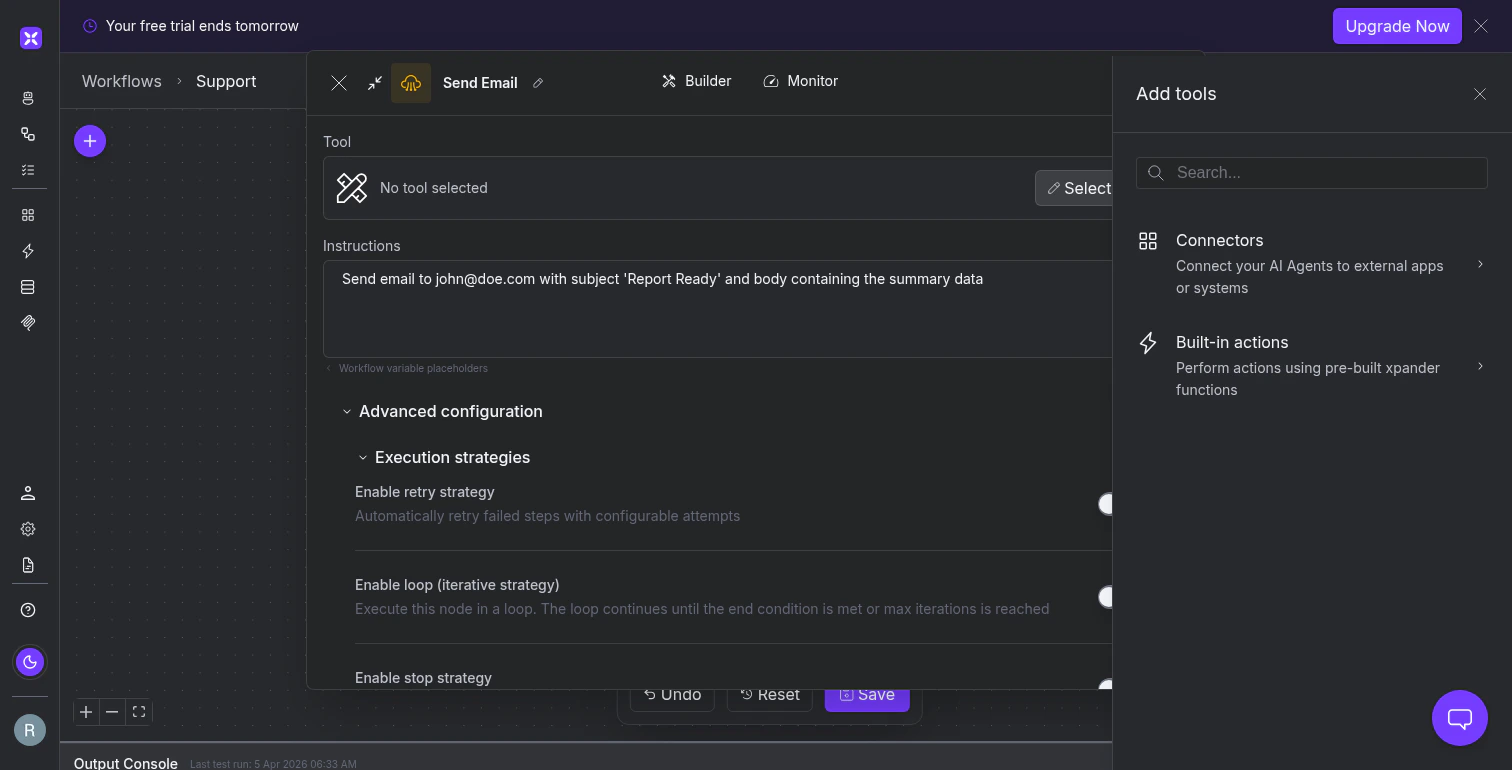
The tool selection panel showing Connectors (2,000+ integrations) and Built-in actions categories.
Run Python code for calculations and transformations
The Code node provides a Python editor directly in the workflow canvas. It has syntax highlighting, line numbers, and comes with scaffold code for a handler function. Execution is deterministic with no LLM involved. Two features extend the Code node beyond a basic script runner: Packages lets you add pip dependencies (type a package name and it’s available at runtime). Needpandas for data manipulation or python-dateutil for date parsing? Add the package and import it.
Generate with AI lets you describe what the code should do in natural language, then review and modify the generated implementation.
The Code node outputs text by default, but you can change the Output type in Advanced Configuration to match what downstream nodes expect.
Loop and stop strategies are available for iterative processing and conditional workflow termination.
Other action node types
The remaining five node types handle specific operations. Each follows the same pattern: select a tool or resource, write instructions, and configure execution strategies in the advanced settings.Email
Sends an email through a connector you choose (Gmail, SendGrid, Outlook, or another email integration). After selecting a tool, the input schema populates with
to, subject, and body_html fields.Use workflow variable placeholders to pull values from previous steps. Retry is particularly useful here since transient email delivery failures are common.OCR
OCR
Extracts text from images and scanned documents. Select an OCR integration, point it at an image via the
file_url input field, and the node returns extracted text for downstream processing. Pair it with a Classifier or Summarizer to structure the output.Custom Function
Custom Function
Calls a reusable function you’ve defined outside the workflow. Select a function from the dropdown (or create one with + New function) and write instructions for how it should be used.The Run asynchronously toggle fires the function without waiting for a result, useful for side effects like audit logging.Use Custom Functions when the same logic appears in multiple workflows, so updates propagate from a single source. For one-off logic specific to a single workflow, the Code node is simpler.
Workflow
Workflow
Runs another workflow as a sub-step. Select a workflow from the dropdown (or create one with + New workflow), and its output becomes the input for the next node in the parent.Like Custom Functions, it supports Run asynchronously for fire-and-forget operations. Use this when a sequence of steps forms a logical unit that could be tested independently or reused across multiple parent workflows.
Upload File
Upload File
Moves files to a destination you specify. Write instructions describing what to upload and where, and configure the destination through the tool input schema in Advanced Configuration.
Choosing the right action node
What’s next
Flow Control
Branch with conditions, validate with guardrails, pause for human approval, and run steps in parallel.
Running & Monitoring
Execute workflows, view results, and debug failed runs.