

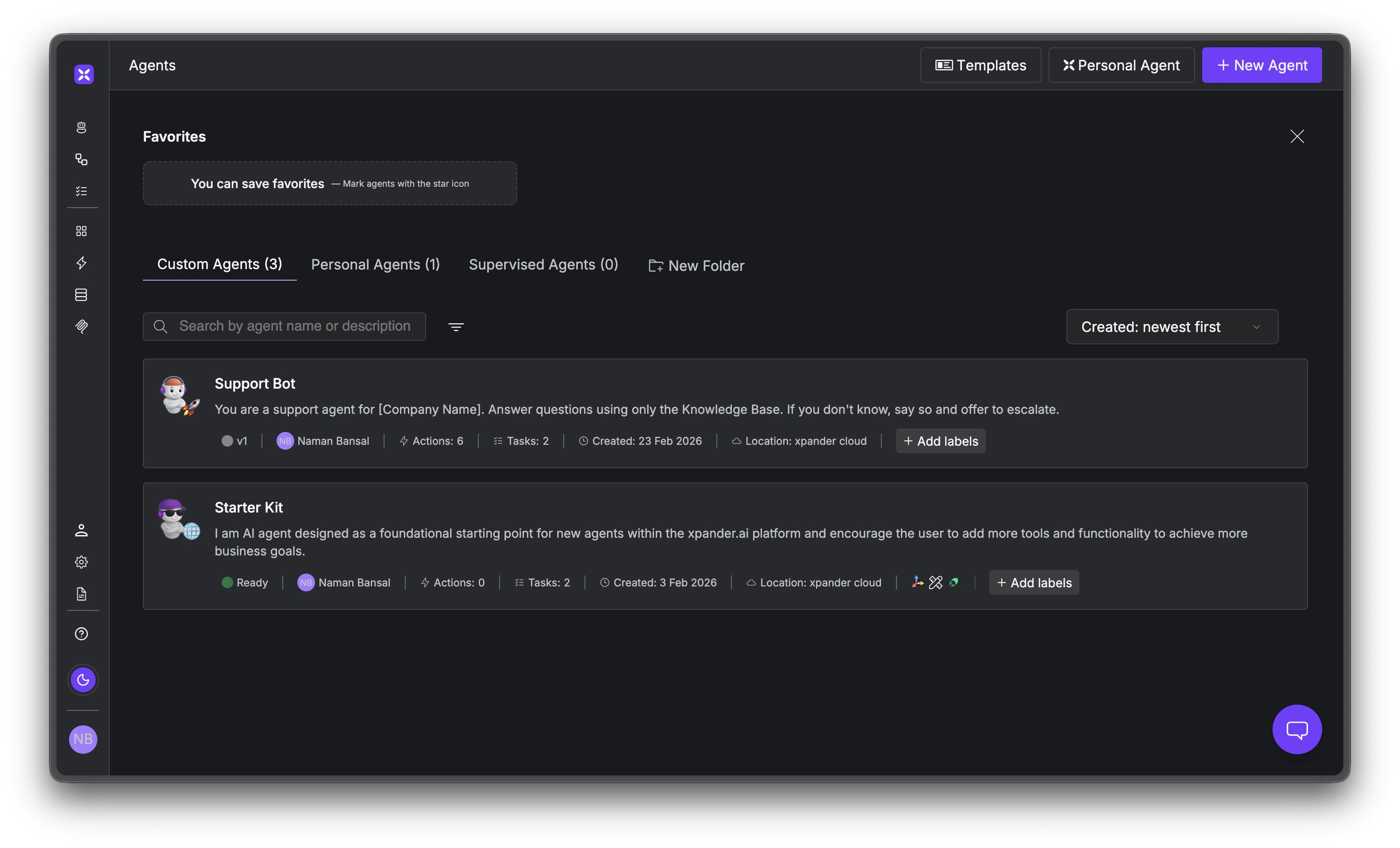
Custom Agents, Personal Agents, and Supervised Agents in one dashboard.
Define behavior with instructions
You describe what the agent should do in plain English. Each instruction becomes an enforced behavioral rule that guides how the agent reasons, what it queries, and what it avoids.Connect your tools
Agents can take action, not just respond. Your agent can query Salesforce, create Jira tickets, send Slack messages, and pull data from Snowflake, all in one conversation.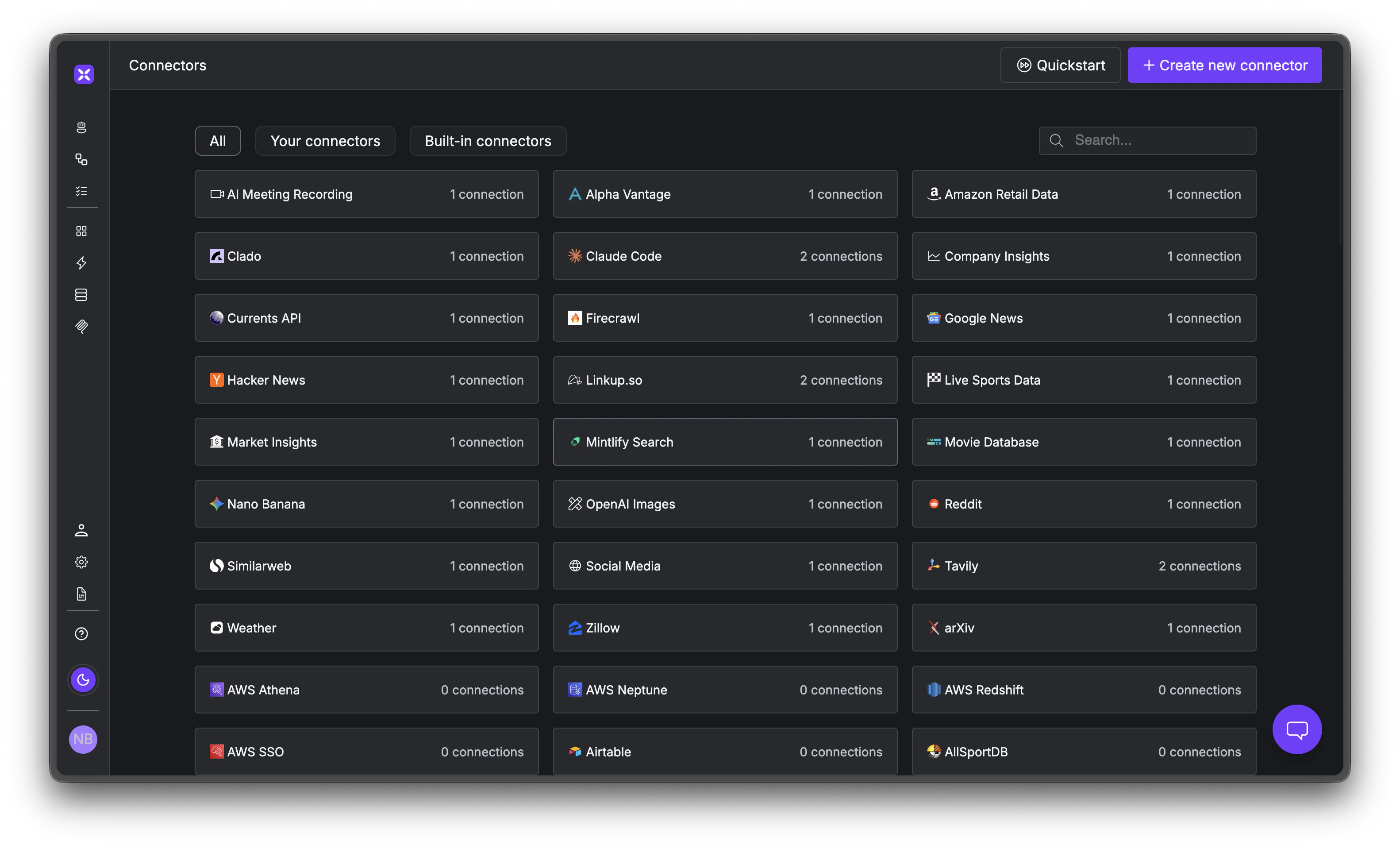
Browse connectors, manage connections, or import any OpenAPI spec.
Knowledge bases
Language models don’t know your internal docs. Without a knowledge base, the agent guesses. With one, it searches your documentation at runtime and grounds its responses in actual content. Upload documents (PDF, spreadsheets, wikis) and they’re automatically chunked and embedded into built-in vector storage that scales to 1M+ records.Upload documents and agents search them at runtime.
Memory
Personal AI Agents handle memory automatically. In Agent Studio, you configure memory settings per agent based on what it needs. Some agents need all three levels: session memory (current conversation), user memories (individual preferences across sessions), and agent memories (org-wide knowledge shared across users). Others only need session memory to stay coherent within a single conversation. You choose what fits. See Personal AI Agents for a full breakdown of the three levels.Safety
Agents with tool access can do real things in real systems, so every agent ships with safety controls you toggle on directly in the builder.- PII detection and masking that redacts personally identifiable information
- Prompt injection protection that blocks instruction override attempts
- Content moderation that filters harmful or off-topic content
- Credential isolation where secrets are injected at infrastructure level, outside model reach
Deploy anywhere
Once your agent is built, pick a model and deploy it to any channel. You can use any provider (OpenAI, Anthropic, Google, AWS Bedrock, NVIDIA NIM) or let OpenClaw select the best model per task automatically. For air-gapped environments, route to local models via Ollama. Bring your own API key or use xpander’s built-in access. Deploy to the REST API, Python/JS SDK, Slack, a chat widget, webhooks, scheduled tasks, MCP protocol (Claude Desktop, Cursor, VS Code), or A2A for agent-to-agent communication. You can also compose multiple agents into teams where a triage agent delegates to specialists automatically. Monitor everything in the Agent Studio: conversation threads, agent metrics, task execution logs with tool call details, and draft vs. live version comparison.What’s next
Quickstart
Build your first agent in 5 minutes.
Core Concepts
Agents, tasks, threads, connectors, and memory.
Building Agents
Agent configuration, tools, knowledge bases, and memory.
Building Workflows
Backend automation on the visual canvas.