

This page is being phased out. For the current way to trace and review agent runs, see Tasks in the User Guide.
Thread list
The left panel lists all threads with key metadata at a glance:- User (name or “N/A” for anonymous/API triggers)
- Last interaction and Created timestamps
- Actions count (tool calls and processing steps)
- Input/Output tokens
- Cost
- Thread ID (UUID)
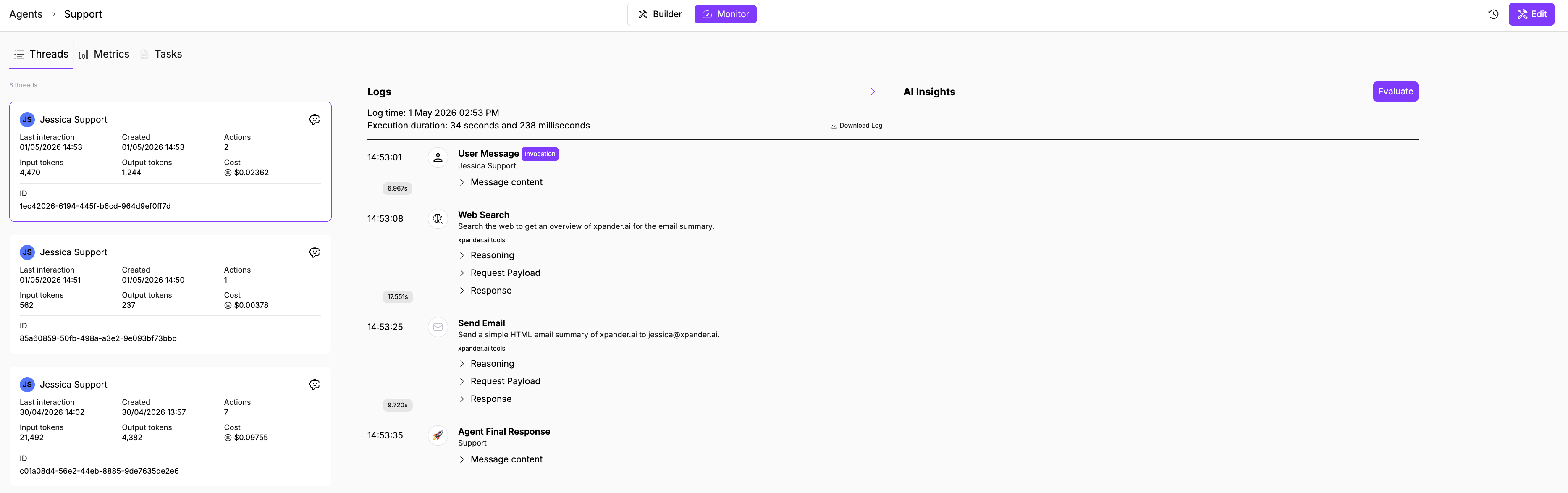
Thread list on the left with 8 sessions. The selected thread's log timeline shows User Message, Web Search, Send an Email and Agent Final Response events with timestamps and execution duration.
Execution log
When you select a thread, the Logs panel on the right reconstructs the full execution step by step. The header shows the log time and execution duration (down to milliseconds). Below it, each step appears in order with a timestamp and expandable sections:
Controls at the top of the log:
- Expand All / Collapse All toggles all expandable sections
- Download Log exports the thread as a JSON file with every message, tool call, and payload
- Expand opens the log panel fullscreen
Trace a problem
When something goes wrong, use the execution log to find where the output diverged from what you expected:- Open Threads and find the conversation by timestamp or user name
- Click into the thread to open the execution log
- Walk through tool calls in order. For each one, expand Request Payload to verify the right data was sent and Response to check what came back.
- Find the step where the output stopped matching expectations.
- If the tool response was correct but the final answer was wrong, the issue is in the agent’s instructions (it misinterpreted the data). If the tool response itself was wrong, the issue is upstream: wrong parameters, missing permissions, or stale data.
AI Insights
Click Evaluate in the AI Insights panel (right side) to run an automated quality assessment on the thread.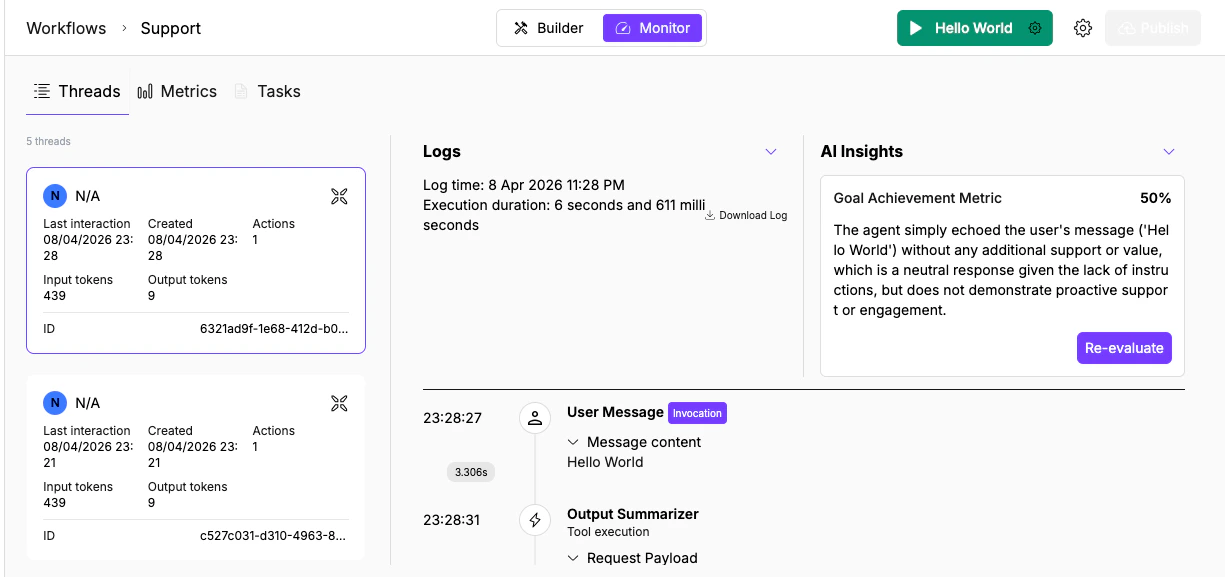
AI Insights panel showing a 50% Goal Achievement Metric with a text analysis of the execution quality.
- Goal Achievement Metric (percentage score): measures how well the agent accomplished what its instructions describe. Below 50% usually means the agent missed a key step or produced incorrect output. Above 80% means the core task was handled correctly.
- Text assessment: a written analysis of what the agent did well and where it fell short. Read this to understand which specific steps contributed to or hurt the score.
What’s next
Task Monitoring
Scan executions by status and triage failures across agents.
Metrics
Spot anomalies in request volume and token usage before diving into individual threads.