

Why the API
A channel is for a person. The API is for a system: a CI pipeline that wants a failure analysed, a ticketing system that hands a case to an agent, a nightly job in your own scheduler, a product that embeds an agent behind its own interface. The run is the same governed conversation as one started in Xpander Chat, with the agent’s skills, approvals, budget and record, and the caller gets the result back in a shape it can parse. Choose the webhook instead when the caller cannot hold a key.Start a run
Three endpoints share one handler and one body:
Authenticate with
x-api-key and an organization API key from Settings > API keys; a key can be limited to named agents. The agent’s Developer access row shows a second address, POST /v1/agents/{agent_id}/conversations/invoke. That one sends a message in a conversation and returns the reply with the conversation record; continue the conversation by sending the next message with its conversation_id. It is the conversation API Xpander Chat itself uses, and its stream variant returns the reply as it is written. By contrast, /invoke starts a one-shot task and returns the task record. Both take the same key. The body needs only the input:
504 after 60 seconds by default, a synchronous call whose turn runs longer never returns. Use /invoke/async and poll the task, or the streaming endpoint, for turns that may take more than a minute.
Useful fields beside input.text:
input.files: URLs the agent readsinput.user: who the run is for, so the record and any per-person credential resolve to themid: an existing conversation id, to continue itadditional_context,instructions_override,titlellm_model_providerandllm_model_namefor this runtool_call_limitsub_tasks_mode:sync,asyncorauto, for sub-tasks the agent itself createsversion=draftas a query parameter, to run the staged version of the agent
Read tasks
GET /v1/tasks lists tasks with filters for agent, user, parent task, status and dates. GET /v1/tasks/{task_id} returns the task, /thread its messages and skill calls, /thread/full the same including every sub-task, /llm_usage its model calls with cost. POST /v1/tasks/{task_id}/stop stops it. Task statuses are pending, executing, paused, error, failed, completed and stopped. The full reference is under REST API.
Get told when a run ends
An agent’snotification_settings, set with PATCH /v1/agents/{agent_id}, send the outcome on success, on error and on budget events to email, Slack or a webhook of yours. The webhook receives the task’s name, subject, body, type, duration, result and a link to the task, with any headers you configured:
Structured output
Four mechanisms, from the one to reach for first:- The agent’s output format. In Agent settings, Output > Structured output takes a JSON Schema; Generate with AI drafts one from a sentence. Every answer is validated against it and repaired when it can be, on every channel, and the API returns the JSON as
result. In Slack and the other chat channels the same answer is rendered as prose for the reader; the record keeps the JSON. This is the setting to use when a downstream system parses the answer.
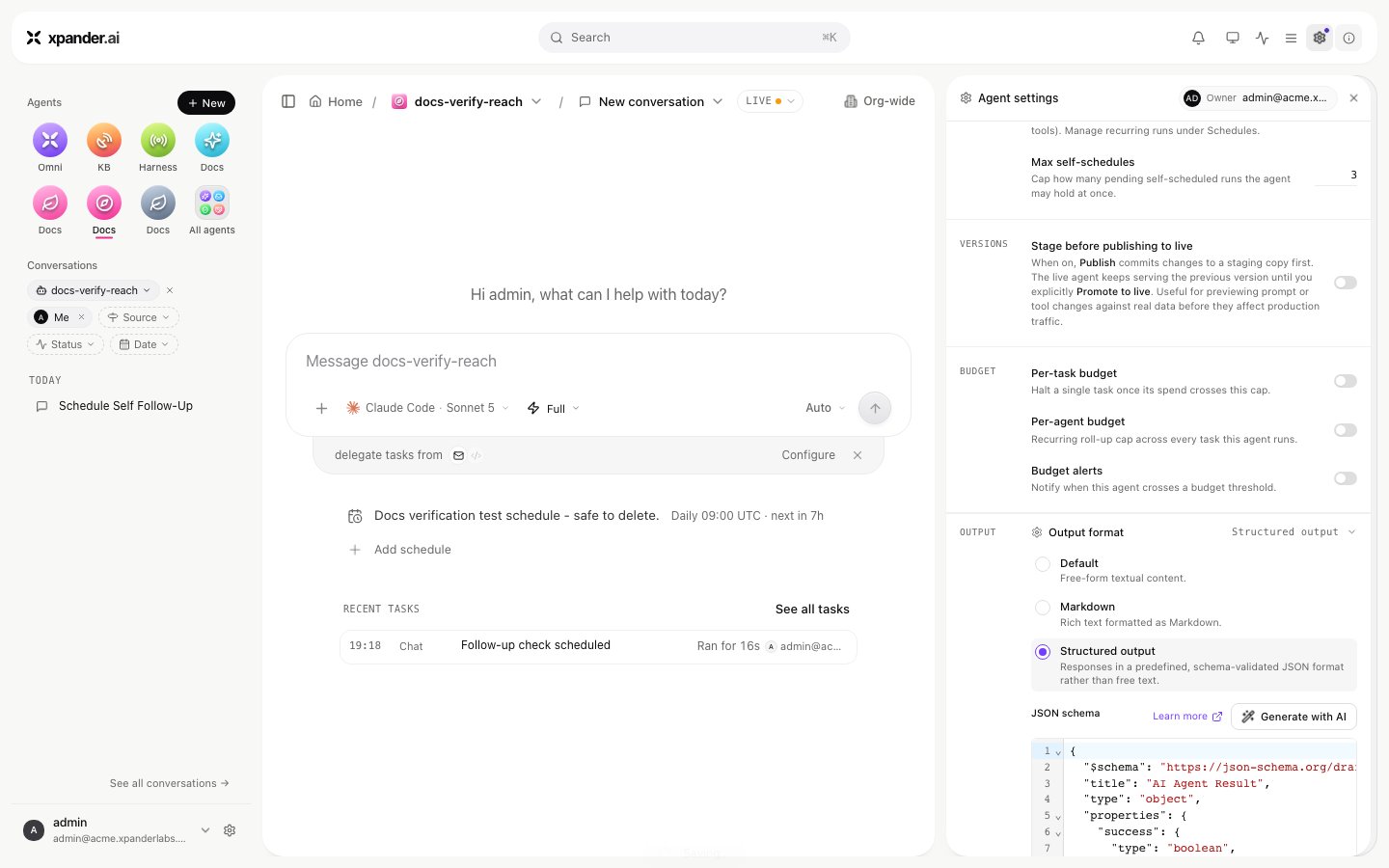
Output > Structured output on a new agent, with the seeded schema.
- The required sections in the instructions. For a human-readable answer that must always carry the same sections, write them into the agent’s static prompt as a contract. Every turn’s prompt carries the instructions, and they are never trimmed.
- A format per channel. A Slack channel routed to the agent can carry its own format instructions, which override the agent’s output format for that channel only; see Channels.
- A schema per call. The invoke body accepts
output_formatandoutput_schemafor one run. It applies to runs the API starts directly; a turn that goes through the agent’s conversation uses the agent-level schema instead, so prefer the agent setting when both are in play.
?getter=result.<field> extracts one field.
The same run from the SDK
The Python SDK wraps these calls (Tasks.create, events, Agents) against the same endpoints; see SDK. Everything on this page also applies to a workflow, at POST /v1/workflows/{workflow_id}/invoke.