

Sending a message
Every message you send is one turn of the conversation. Xpander Chat opens a stream and shows the turn as it happens: your message as a bubble, the agent’s text as plain paragraphs streamed token by token, and each skill call as a collapsed row (a chevron, the skill’s icon and its title) you can expand into Summary (what it asked, what came back) or Full (the raw call). The conversation keeps the whole thread. The turn runs on xpander, not in your browser. Closing the tab, a deploy or a network drop does not stop it. If the stream breaks, Xpander Chat polls the run’s state for half a minute and then tells you the reply is saved in the thread. Turns in one conversation run one at a time. A second message sent while a turn is running is steered into it: it reaches the agent at its next skill boundary and shows in the thread as a steering message, so a correction lands in the work in progress instead of waiting for it to end. From Slack the steered message gets an eyes reaction; from WhatsApp and Telegram it is silent. With nothing running, a message starts the next turn.Sub-tasks
An agent can hand part of the work to another agent as a sub-task: a separate execution with its own record, listed under the conversation and in the Task Manager. The agent decides whether to wait for it or let it run on when it creates it. The API’s sub-task mode (sync, async or auto) says how the agent’s own sub-tasks run inside the turn: inline, queued, or the agent’s per-task choice. A sub-task that runs on reports into the conversation when it finishes, and a sub-task never fans out background sub-tasks of its own. Turns from Slack, Teams, WhatsApp and email are created with the inline mode, so the channel reply is the whole answer. Omni, the built-in agent, is an agent like the others: asking it to task another agent creates that agent’s own conversation, and the result comes back into Omni’s thread.
Where the work runs
Every turn runs in a sandbox in the location the agent belongs to: xpander’s cloud, or a self-hosted location your organization connected (see Locations). Model calls leave through xpander’s LLM proxy; skill calls go to the controller, where the credential is attached and the call is recorded. The mechanics are on Agents and conversations.Uploading a file
Attach a file in the composer, up to 50 MiB. Two things happen:- The file is stored in the file store for your organization, and its link is part of the message.
- It is copied into the conversation’s working directory under
uploads/<name>, so the agent reads it as a file. When the copy fails you are told the agent will read it from the link instead. Images and documents are also handed to the model directly when the model accepts them.
Results and the files an agent produces
The conversation shows the answer; the task panel shows the files created or changed, token usage and cost. Files live in the conversation’s working directory, browsable in the Computer view, where you can open, edit, upload and download them. Hidden entries are dimmed, and credential stores such as.aws, .ssh and .kube never appear. Share on a file mints a link with an audience: Just me, My org (anyone in the organization with the link), or Public (anyone on the public internet with the link) where an admin allows public links under Settings > Sharing. A link the agent shares on its own is public unless public sharing is off for the organization. Make live on a document the agent produced turns it into a live surface the agent keeps updated on each run.
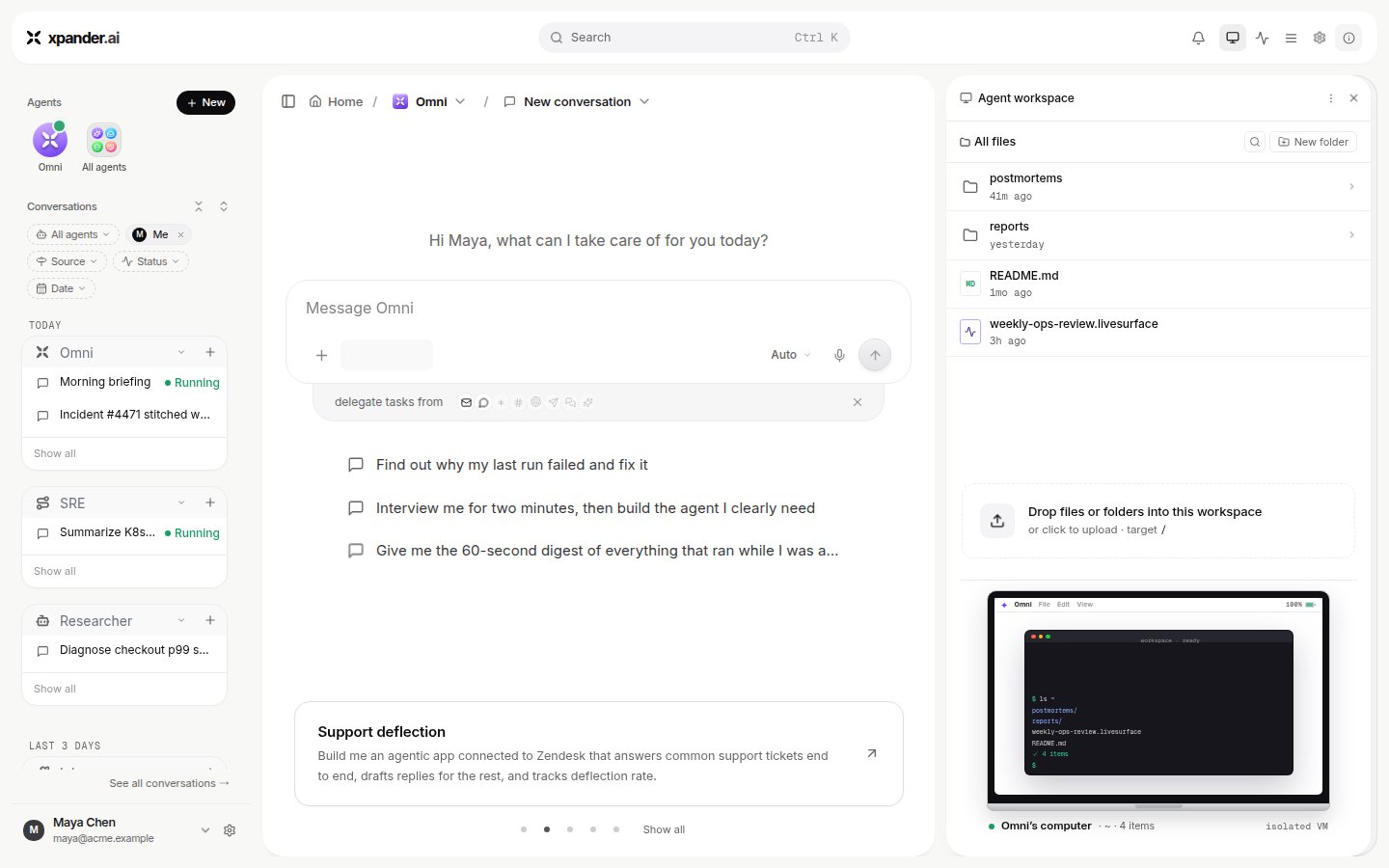
The Computer view: the conversation's working directory as a file browser.
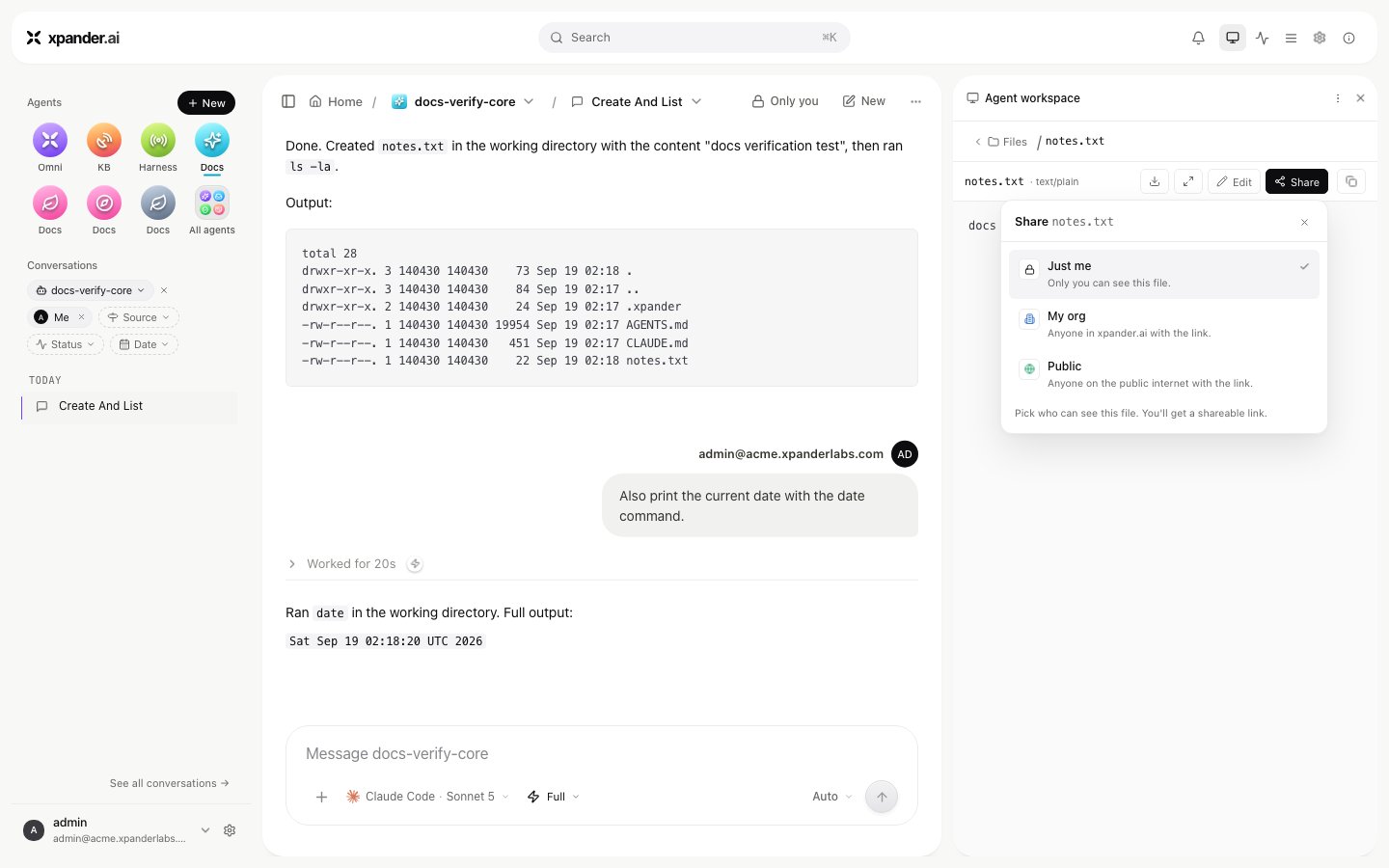
Share on a file: Just me, My org or Public.
The task record
Every conversation and every sub-task is a task with the same record; a conversation’s record carries the latest turn’s status and result, and its thread holds every turn’s messages and skill calls. Conversations recorded before September 2026 (conversation_kind: gateway) are read-only; start a new conversation with the agent to continue. Every task has:
- status:
pending,executing,paused,error,failed,completedorstopped - the messages
- every skill call, with its parameters, result and the credential it used
- held approvals and their decisions
- files, tokens and cost
- the model that ran it
GET /v1/tasks/{task_id} returns it, /thread its messages, /llm_usage its model calls. A failed action shows a readable line with the raw error text kept alongside it. Failures on xpander’s side show as Budget limit reached, Out of credits, Quota reached or Account blocked, not as a stack trace. More on Audit and debugging.
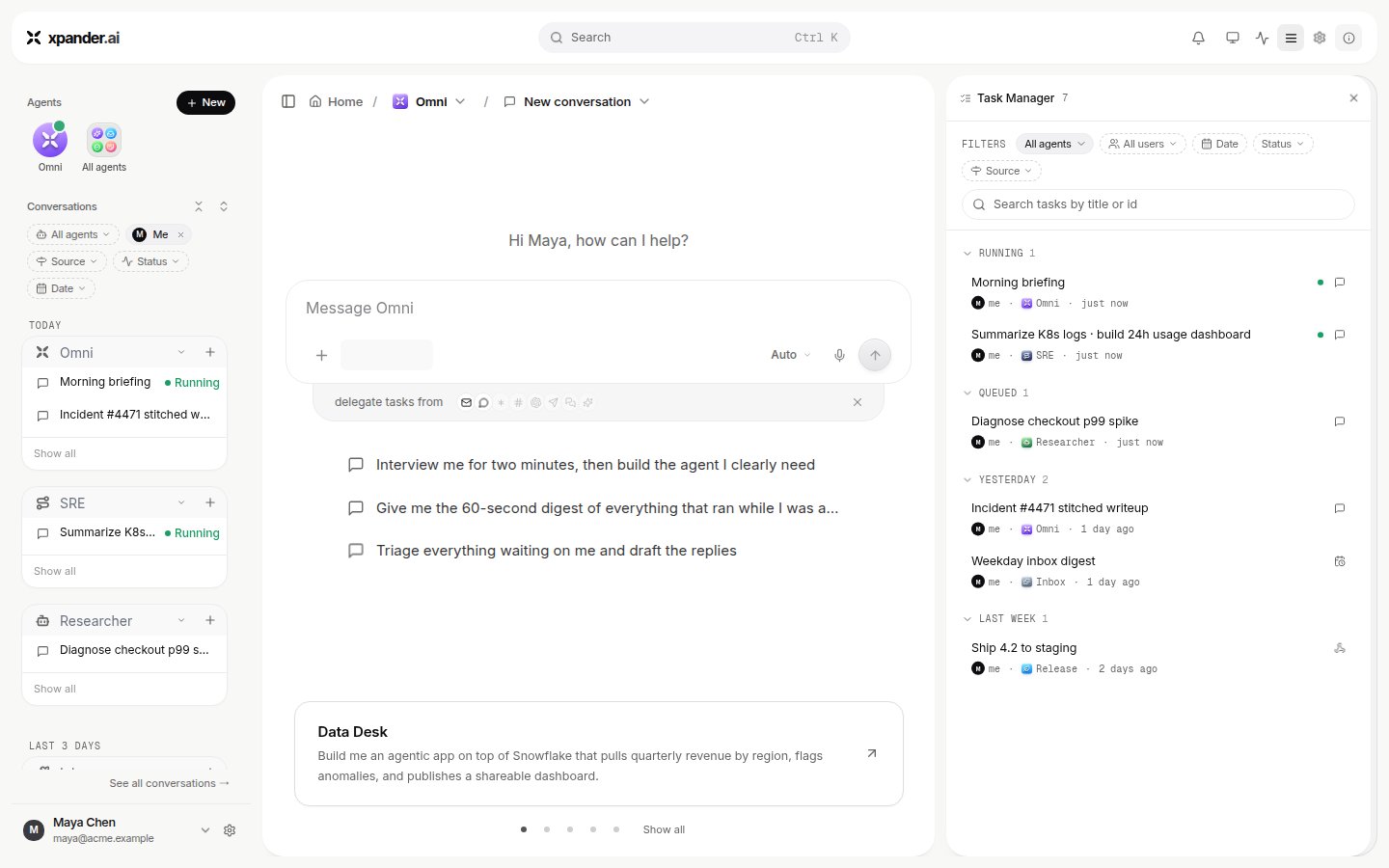
Task Manager: every task for an agent, filtered by date, status and source.